How 3D Printed Magnets Emerged?
3D printed magnets are permanent magnets or magnetic components produced by additive manufacturing, most commonly by printing polymer-bonded magnetic compounds layer by layer into the required geometry.
Interest in this approach grew rapidly in the mid-2010s, when additive manufacturing was expanding beyond plastic prototypes into functional materials and industrial manufacturing.
One of the most influential early demonstrations came from Oak Ridge National Laboratory in 2016. Using Big Area Additive Manufacturing (BAAM), researchers produced isotropic bonded Neodymium magnets from a compound containing 65 vol% magnetic powder and 35 vol% Nylon-12. The printed magnets achieved magnetic properties comparable to injection molded magnets made from the same composition.
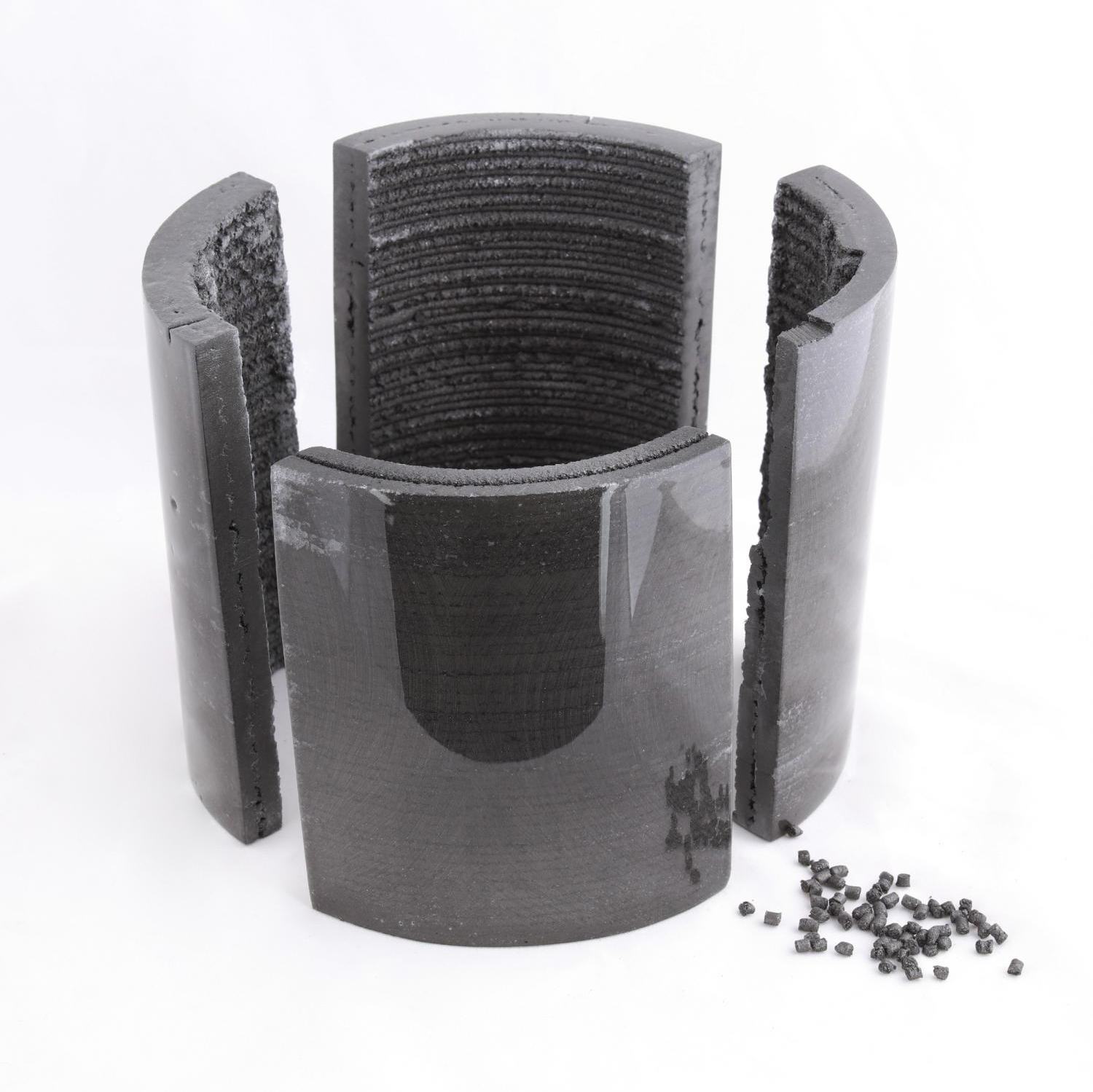
The significance of the work went beyond proving that bonded magnetic compounds could be printed. Additive manufacturing was presented as a way to produce complex shapes with minimal material waste while eliminating the need for shape-specific molding tools. It also appeared attractive for rapid prototyping and low-volume production, where developing a new mold for every design could add cost and lead time.
This proposition was particularly compelling because additive manufacturing had already demonstrated clear advantages in plastic prototyping. A CAD model could be converted directly into a physical part without first developing an injection mold. Since bonded magnets are also polymer-based composites, applying the same manufacturing logic to magnetic materials seemed like a natural extension.
Research on additively manufactured magnets has since become much more sophisticated. What deserves another look, however, is the original manufacturing proposition itself. Permanent magnets are not simply shaped polymer components: their function also depends on magnetic material content, orientation when required, final magnetization, and the resulting magnetic field.
After roughly a decade of development, the question is therefore no longer simply whether permanent magnets can be 3D printed. It is whether eliminating the forming mold actually removes the important constraints in prototyping and manufacturing functional permanent magnets.
How Additive Manufacturing of Magnets Has Evolved?
Early research on 3D printed magnets focused mainly on isotropic bonded materials. Extrusion-based processes such as FFF and BAAM demonstrated that highly filled magnetic compounds could be formed without conventional molding, while later studies continued to increase magnetic-powder loading and improve printed density.
Research then moved toward anisotropic materials, where particle orientation became an additional manufacturing challenge. Post-printing alignment was followed by approaches that applied magnetic fields during deposition, allowing anisotropic particles to align while the material was still mobile. More recent work has also explored local in-situ alignment, turning particle orientation itself into part of the printing process.
Additive manufacturing was also extended beyond uniform magnetic parts. Researchers demonstrated magnets with spatially varying magnetic-material content to produce predefined stray-field distributions, while other studies explored stereolithography, powder-bed processes, and routes toward dense or sintered magnetic materials.
Over roughly a decade, the research landscape therefore expanded from isotropic to anisotropic materials, from post-alignment to in-situ alignment, from uniform compositions to spatial material distribution, and from polymer-bonded magnets toward dense or sintered routes. The technology became considerably more sophisticated, while the original value proposition—complex geometries, rapid prototyping, reduced waste, and no molding tools—remained remarkably similar.
Why Bonded Magnets Remain the Natural Fit for 3D Printing?
Bonded magnets remain the most natural fit for additive manufacturing because the polymer required for printing is already part of the magnetic material system. Magnetic powder is mixed with a thermoplastic or other polymer binder to form a printable feedstock, much as it is compounded for conventional injection molded bonded magnets.
This makes isotropic bonded magnets particularly straightforward to print. The magnetic particles do not need to be aligned during forming, so the main processing challenge is achieving sufficiently high magnetic-powder loading while maintaining acceptable flow and printability. Higher loading generally improves density and magnetic performance, but also makes extrusion or deposition more difficult.
The polymer fraction still places an inherent limit on magnetic material content. Printing can approach the density of comparable molded bonded compounds, but it does not remove the performance gap between bonded and fully dense sintered magnets. Voids, layer interfaces, and process-dependent packing can introduce additional differences between the printed part and the original compound.
Anisotropic bonded magnets offer higher magnetic potential, but they also make the process more complicated. Their particles must be oriented before the polymer solidifies, requiring an external magnetic field during or after forming. At that point, additive manufacturing is no longer concerned only with depositing the correct geometry; it must also control how the magnetic material is oriented within that geometry.
This distinction becomes even more important when additive manufacturing is extended toward sintered magnets. In bonded magnets, the polymer is part of the finished material. In sinter-based routes, the binder is temporary and must later be removed without introducing excessive carbon, oxygen, porosity, distortion, or loss of alignment.
No Mold Does Not Mean No Tooling
One frequently cited advantage of 3D printed magnets is the elimination of molding tools. This comparison makes intuitive sense for plastic prototypes, but it becomes less complete when applied to permanent magnets. A plastic part can often be printed and tested immediately, while a printed magnetic part still has to acquire the magnetization required for its intended function.
This distinction is clear for isotropic bonded magnets. They do not require particle alignment during printing, but the printed part is not a functional permanent magnet. It still has to be magnetized after forming. Simple axial or diametrical magnetization may be achieved with general magnetizing equipment, but multipole patterns, small pole pitches, or specialized field distributions can require dedicated magnetizing fixtures.
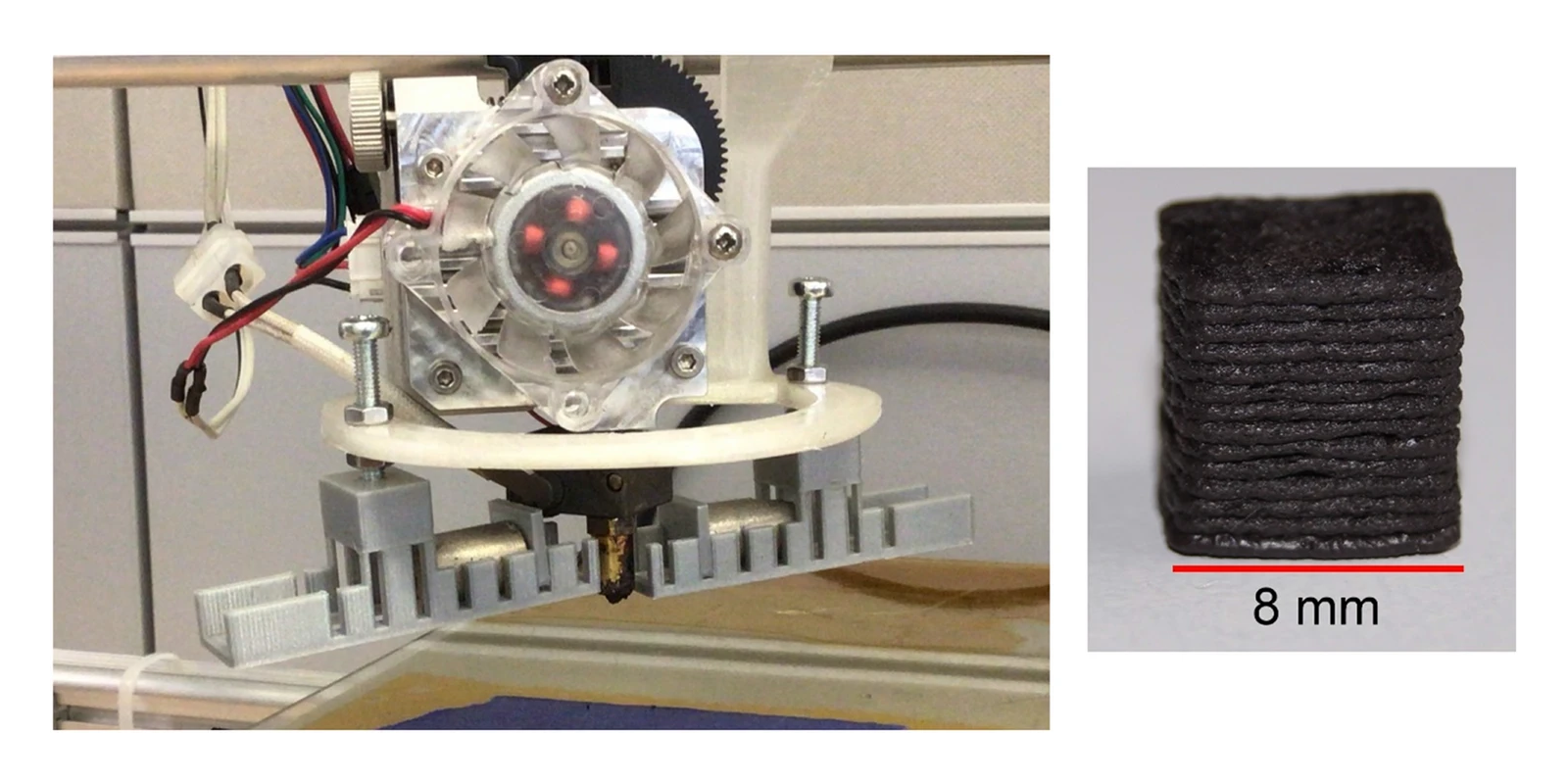
The difference becomes greater with anisotropic bonded magnets. Their higher magnetic potential depends on aligning the easy axes of the magnetic particles, which introduces an additional magnetic field requirement during or after forming. Research on field-assisted and in-situ alignment therefore adds magnetic hardware and process control to the printing system rather than eliminating tooling altogether.
This is an important difference between structural prototypes and magnetic functional components. For many plastic parts, geometric completion is close to functional completion. For permanent magnets, geometry is only part of the design. Material content, particle orientation where required, magnetization direction, pole pattern, and the resulting magnetic field all contribute to the final function.
Additive manufacturing can therefore eliminate a shape-specific forming mold, but it does not necessarily eliminate magnetic tooling. In applications where the required magnetic field is more complex than the printed geometry itself, the magnetizing process may remain one of the main constraints on rapid functional prototyping.
Is 3D Printing Really Better for Magnetic Prototyping?
Rapid prototyping is another commonly cited advantage of 3D printed magnets. Compared with injection molding, the argument is straightforward: a new geometry can be printed directly from a CAD model without first producing a dedicated mold. For permanent magnets, however, injection molding is not the only practical route to a prototype.
Where suitable bonded magnet stock or near-size blanks are available, a small number of prototypes can also be produced by conventional cutting, grinding, or other subtractive machining. This approach wastes more material, but material utilization is rarely the main concern when only a few parts are required for functional evaluation.
More importantly, machining starts from an already consolidated magnetic material. Its density and magnetic properties may therefore be more representative of the intended molded production material than those of a printed prototype, where porosity, layer interfaces, or incomplete packing can introduce additional differences.
Both routes still have to reach the required magnetization state before the magnetic function can be evaluated. For simple magnetization patterns, this may add little difficulty. For more specialized pole patterns, however, the same magnetizing fixture may be required regardless of whether the geometry was printed or machined.
The relevant comparison for magnetic prototyping is therefore not simply 3D printing versus injection molding. It may also be 3D printing versus machining an existing magnetic blank. If both routes still require magnetization, and machining can provide material properties closer to the intended production part, eliminating the forming mold alone may offer less prototyping advantage than it first appears.
Can 3D Printing Compete with Sintered Neodymium Magnets?
The much larger challenge is extending additive manufacturing beyond bonded magnets toward the performance of conventional sintered Neodymium magnets. High density alone is not sufficient. Their magnetic properties depend on grain orientation, phase distribution, grain-boundary chemistry, oxygen control, and carefully controlled sintering and heat treatment.
One approach is to print a powder-binder feedstock and subsequently remove the binder and sinter the remaining magnetic powder. In manufacturing terms, this moves additive manufacturing much closer to established powder-metallurgy and MIM-type processing. The printed shape is only a green body; debinding, shrinkage, distortion, porosity, carbon and oxygen contamination, particle alignment, sintering, and heat treatment all remain to be controlled.
This is particularly awkward for Neodymium magnets because the temporary binder solves the shaping problem by introducing another material that must later be removed without damaging the chemistry or microstructure required for high coercivity. If anisotropic powder is used, magnetic alignment must also be established before the structure is fixed, while final magnetization is still required after sintering.
Direct processes such as laser powder-bed fusion avoid the polymer binder, but replace those difficulties with others. Melting and rapid solidification can alter the phases and microstructure that give sintered Neodymium magnets their magnetic performance. Dense parts can be produced experimentally, but density by itself does not make them equivalent to conventionally sintered magnets.
This leads to a practical manufacturing question. If the required geometry can already be produced from a conventional sintered magnet blank by cutting, grinding, or other established machining methods, what problem is the additive route actually solving? Conventional processing begins with a mature magnetic material and modifies its geometry. Sinter-based additive manufacturing must instead rebuild both the shape and the magnetic microstructure through a considerably more complicated process.
Additive manufacturing may still be valuable where it enables structures, material distributions, or magnetic designs that conventional molding and machining cannot practically produce. In those cases, however, its value comes from a capability unique to additive manufacturing—not simply from eliminating a forming mold.
After more than a decade of research, the more useful question may therefore be not whether permanent magnets can be 3D printed, but when additive manufacturing provides an advantage that conventional magnet manufacturing does not already offer.