Ι What Are Orientation Directions?
Orientation refers to the process in magnet manufacturing where a magnetic field is applied to align the magnetic domains along a specific direction. This process is similar to magnetization, but it occurs earlier in production—either during the molding of un-densified magnetic powders or during heat treatment of alloys that have not yet fully formed their final phase. The goal is to align the magnetic domains as uniformly as possible along the magnetic field. The higher the alignment (or “orientation degree”), the better the magnet’s final magnetic performance. Based on whether orientation is necessary, magnets are classified into two categories: anisotropic magnets, which require orientation, and isotropic magnets, which do not.

For anisotropic magnets, the orientation process determines both the magnet’s magnetization direction and overall performance. The magnetization of anisotropic magnets involves applying a magnetic field along their orientation direction to achieve technical saturation.
The directions in which anisotropic magnets achieve their best magnetic performance are called the orientation directions, also known as the orientation axis or easy magnetization axis. These orientation directions are crucial for achieving optimal magnetization.
Orientation Directions Vs. Magnetization Directions
The orientation directions refer to the alignment of magnetic domains during the manufacturing process, which sets the stage for the magnet’s magnetization. The magnetization direction describes how the magnet’s domains align when an external magnetic field is applied.
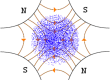
For anisotropic magnets, the orientation directions are crucial, as the domains are aligned along a specific axis, and magnetization occurs along that axis for optimal performance. Isotropic magnets, on the other hand, do not require orientation because their domains are randomly aligned, allowing magnetization to happen in any direction.

Isotropic Magnets

Anisotropic Magnets
How to Orient a Magnet?
Different types of magnets utilize different orientation methods, with the most common being magnetic field orientation. This process can be divided into two types: orientation during the molding process and orientation during heat treatment. For magnets such as Neodymium, Samarium Cobalt, ferrite, and anisotropic injection molded magnets, a magnetic field is applied during the molding process to align the magnetic powder particles. This ensures that the easy magnetization direction of the particles aligns with the final magnetization direction of the magnet.
For anisotropic AlNiCo magnets, magnetic field orientation is achieved through heat treatment after casting or sintering. The magnet is heated above the Curie temperature and then cooled at a controlled rate under a magnetic field. During this process, the α1 phase grains precipitate and elongate along the direction of the magnetic field. At the same time, Co atomic pairs become ordered and aligned with the magnetic field, resulting in shape-anisotropic crystals. This significantly enhances the material’s remanence, coercivity, and energy product.
Additionally, two specialized methods are used for magnet orientation. Stress-induced crystallographic orientation is applied to hot pressed Neodymium magnets, where plastic deformation at elevated temperatures causes the crystalline structure to align without the need for an external magnetic field. The Nd2Fe14B main phase has a tetragonal structure, and the elastic modulus of the easy magnetization axis is relatively low. As a result, the easy magnetization direction of isotropic nanocrystalline Neodymium magnets will align along the pressure direction, forming the preferred orientation. On the other hand, stress orientation is used for calendared magnets, where mechanical stress during the rolling or calendaring process aligns the magnetic domains in the direction of the applied stress.