Pole Count Shapes Multipole Magnets
Multipole magnets are often described by the number of magnetic poles arranged on a working surface. For ring magnets, these poles are usually distributed around the circumference. For flat or linear magnets, the poles may be arranged along a specific surface or path. In many projects, pole count is one of the first parameters discussed because it directly affects the magnetic field pattern.
However, pole count should not be judged simply as higher or lower. More poles can be useful in some applications, but they can also create new limits in working distance, signal stability, magnetization, and inspection.
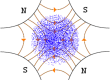
For close-contact holding applications, increasing the number of alternating north and south poles on the working surface may improve local holding force when the magnets work with a matching mating part.

The magnetic circuit becomes concentrated near the contact area, which can make multipole magnetization useful for magnetic sheets, magnetic closures, and other short-distance adsorption designs.
For sensing applications, a higher pole count can create more magnetic cycles within one rotation or along a defined movement path. This may provide more signal periods for position detection, but only when the sensor can clearly resolve the magnetic pattern at the actual working air gap.
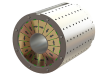
For motor applications, the logic is different again. The pole count of multipole ring magnets is usually determined by the motor design rather than by the magnet itself. Depending on the slot-pole combination, rotor structure, and electromagnetic design, different pole numbers may be specified for the same general magnet type. In these cases, the main question is not whether more poles should be added, but whether the specified pole count can be clearly magnetized within the required ring size, wall thickness, working surface, waveform requirement, and rotor assembly structure.
This is why multipole magnet design should not begin with the simple question of “how many poles can be made.” A more useful question is how the selected pole count will work in the actual application, including close-contact holding force, working distance, signal stability, magnetic flux density, magnetization difficulty, inspection method, and whether the specified pole count can be realized within the required magnet size and structure.
Pole Pitch Defines Multipole Magnets
Pole count is easy to describe, but pole pitch is often more important in actual multipole magnet design. Pole pitch refers to the distance or angular spacing between adjacent magnetic poles. For multipole ring magnets, it is related to the diameter of the working surface where the poles are arranged and the number of poles distributed around the circumference.
When the magnet size remains unchanged, increasing the pole count reduces the pole pitch. This means each magnetic pole occupies a smaller area on the working surface. A smaller pole pitch can create a denser magnetic field pattern, but it also changes how the magnet works with the mating part, sensor, or magnetic circuit.


For close-contact holding applications, smaller pole pitch may help concentrate the magnetic circuit near the working surface and improve local holding force. For sensing applications, smaller pole pitch may provide more signal periods in a limited space. For motor applications, pole pitch affects whether the specified pole count can be clearly magnetized within the required ring size and working surface.
However, smaller pole pitch also makes the design more sensitive. The usable magnetic effect may become more dependent on air gap, assembly position, magnet thickness, magnetizing fixture, and inspection method. This is why pole pitch should be reviewed together with the magnet size, application requirement, and manufacturing route, rather than being treated as a simple result of pole count.
When More Poles Improve Close-Contact Holding Force?
More poles can improve multipole magnets when the application depends on close-contact holding force. In these designs, alternating north and south poles are arranged on the working surface, allowing the magnetic circuit to close over a short distance through a mating part.
This concentrated magnetic circuit can increase the local holding force near the surface. For this reason, multipole magnetization is often useful for magnetic sheets, magnetic closures, and other short-distance adsorption designs where the magnet and mating part work very close to each other.
However, this advantage depends strongly on working distance. A multipole pattern that provides strong holding force at direct contact may lose its effect quickly when an air gap is introduced. If the mating part is too far away, too thin, poorly matched, or not magnetically conductive enough, adding more poles may not bring the expected improvement.

This is why close-contact holding applications should be reviewed together with the working surface, pole pitch, magnet thickness, mating part material, contact condition, and allowed air gap. More poles may improve local holding force, but only when the magnetic circuit can actually close through the mating part.
Smaller Pole Pitch Makes Sensors More Air-Gap Sensitive
For sensing applications, smaller pole pitch means the magnetic pattern changes more frequently along the sensing path. This can provide more signal periods within one rotation or linear movement, which may be useful for magnetic encoders, magnetic scales, and other position detection systems.
However, the sensor must be able to resolve this finer magnetic pattern at the actual working air gap. When the air gap increases, the magnetic variation created by small pole pitch may become weaker or less distinguishable. The sensor may still detect a magnetic field, but the useful signal pattern may no longer be clear enough for stable position detection.
This is why high pole count multipole magnets can become more sensitive to sensor position, air gap, eccentricity, radial runout, axial movement, and assembly tolerance. A small change in the relative position between the magnet and sensor may cause signal amplitude variation, waveform distortion, or unstable detection.

For this reason, pole count in sensing applications should not be selected only by the desired number of signal periods. The actual detection distance, sensor type, magnet size, pole pitch, magnetic flux density distribution, and mechanical tolerance should all be reviewed together. More poles may provide more signal information, but only when the sensor can read the magnetic pattern clearly and reliably at the working position.
Motor Pole Count Is Usually Design-Driven
In motor applications, the required pole count is usually specified before the magnet is reviewed. The practical question is whether this pole count can be clearly magnetized within the required ring size, wall thickness, working surface, and rotor assembly structure.
For multipole ring magnets used in motors, different magnet sizes may still use the same pole count if the motor design requires it. At the same time, similar ring sizes may use different pole counts in different motor systems. This is why pole count should be reviewed together with the slot-pole combination, rotor structure, waveform requirement, and magnetization process.
The key review point is manufacturability. If the working surface is too small, the wall thickness is limited, or the pole pitch becomes too narrow, the magnetizing fixture may have difficulty creating a clear and consistent magnetic pattern. The final magnetic flux density waveform, pole boundary, and magnetization consistency should be reviewed together with the motor requirement.

For this reason, motor-related multipole magnet projects should not be judged by whether more poles can be added. They should be evaluated based on whether the specified pole count can be realized reliably within the required magnet dimensions and assembly conditions.
Manufacturing Limits of Fine-Pitch Magnetization
Fine-pitch multipole magnetization is not only a design question. It is also limited by the magnetizing fixture and the magnet material itself. When the pole pitch becomes smaller, the fixture must generate closely spaced magnetizing fields on the same working surface. This makes the conductor layout, insulation, cooling, and current path design more difficult.
For very small pole pitch, there may not be enough space inside the magnetizing fixture to create a strong and clearly separated magnetizing field. The fixture may need smaller conductors and a tighter current path, but this can limit the current-carrying capacity and reduce the effective magnetizing field that reaches each pole area.
This becomes more challenging for high-coercivity magnets. Materials such as sintered Neodymium (NdFeB) magnets usually require a strong magnetizing field to reach full magnetization. If the pole pitch is too small, the magnetizing fixture may not be able to provide enough local field strength to magnetize each pole clearly and consistently.
This is why very fine multipole patterns are often easier to realize on low-coercivity materials, thin magnetic parts, or flexible magnetic sheets. These products may require lower magnetizing fields and allow finer pole patterns to be formed more easily. For high-coercivity permanent magnets, especially thicker sintered Neodymium magnets, fine-pitch multipole magnetization should be reviewed carefully before the design is treated as manufacturable.
In practical projects, the feasibility of fine-pitch magnetization depends on the magnet size, working surface, pole pitch, material grade, thickness, magnetization direction, fixture capability, and required magnetic pattern. A high pole count may look possible in a drawing, but the real question is whether the magnetizing process can create stable, repeatable, and usable poles on the finished magnets.
Send Us Your Multipole Magnet Requirements
Pole count should be reviewed together with the magnet size, working surface, pole pitch, material grade, magnetization direction, working distance, and final application. For multipole ring magnets, sensor magnets, magnetic closures, or other customized multipole magnets, the feasibility may depend on both magnetic performance and magnetizing fixture capability.
Send us your drawing, required pole count, magnet dimensions, material grade, working surface, and application details. SDM can help review whether the selected pole count is suitable, manufacturable, and practical for the final assembly.