What Is Security Tag Remover?
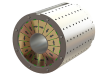
The term security tag remover refers to a device used by retailers to detach electronic article surveillance (EAS) hard tags from clothing, bags, and other merchandise at checkout counters. Magnetic security tag removers, also known as magnetic detachers, use the magnetic force generated by permanent magnets to release compatible locking mechanisms.
Magnetic detachers are available in different configurations, including countertop, recessed, and handheld designs. However, their differences extend beyond appearance and installation.
EAS hard tags employ different locking mechanisms and may require different levels of magnetic force to release, meaning that magnetic security tag removers are not universally interchangeable. Compatibility therefore depends on both the locking mechanism and the magnetic performance of the detacher.

How Do Magnetic Security Tag Removers Work?
Magnetic EAS hard tags commonly use spring-loaded ball-clutch mechanisms to secure their attachment pins. Inside tapered chambers, steel balls grip the pins and prevent them from being withdrawn. Depending on the design, attachment pins may have smooth shafts or circumferential grooves, with locking mechanisms relying on friction, mechanical engagement, or a combination of both.
When compatible security tags are placed on magnetic detachers, permanent magnet assemblies exert attractive forces on ferromagnetic components inside the locking mechanisms.
Once these forces overcome the spring resistance, movable components shift, allowing the steel balls to release their grip on the pins. Magnetic security tag removers therefore disengage the locking mechanisms rather than pulling the pins out directly.


Locked and Unlocked States
Because the locking components are enclosed within tag housings, effective release depends on the magnetic forces available at their actual positions, rather than simply the surface Gauss ratings of the detachers.
What Do 10,000, 12,000, 15,000, and 20,000 Gauss Mean?
Commercial magnetic security tag removers are commonly advertised with Gauss ratings of 10,000G, 12,000G, 15,000G, and even 20,000G. These figures are generally presented as indicators of magnetic strength, with higher ratings often marketed as offering stronger magnetic performance and broader compatibility with EAS hard tags.
However, these advertised values should not be interpreted as standardized performance grades. Gauss readings depend on the measurement location, probe orientation, and distance from the magnetic assembly. Measurements taken directly at the magnet surface may differ considerably from those taken at the outer housing or working surface of security tag removers.
Many commercial product listings provide little information about measurement methods, and some even contain inconsistent Gauss specifications. Such discrepancies raise questions about the reliability of advertised ratings, making direct comparisons between different magnetic detachers difficult. More importantly, Gauss ratings describe magnetic flux density rather than the actual magnetic force required to release EAS locking mechanisms.
Does Higher Gauss Mean Better Detaching Performance?
Higher Gauss ratings generally indicate stronger magnetic performance, particularly when magnetic detachers share similar designs and are measured under comparable conditions. This can be beneficial when releasing EAS hard tags with higher unlocking requirements. However, Gauss ratings alone are not sufficient to evaluate detaching performance across different magnetic detacher designs.
The magnetic force must act on the movable components inside the EAS locking mechanisms, rather than simply at the detachers’ working surfaces. Since these components are located at a certain distance from the magnetic assemblies, their actual positions become important. The resulting magnetic force depends on both the local magnetic flux density and its spatial gradient. Higher Gauss readings at the surface do not necessarily translate into proportionally greater magnetic forces at the locking components.
The locking mechanisms themselves also influence detaching performance. Spring resistance, internal geometry, and the direction of movement determine how much magnetic force is needed for release. Therefore, the objective is not simply to maximize Gauss ratings, but to generate sufficient magnetic force at the required working positions. This is where the magnetic arrangement and circuit design of security tag remover magnets become particularly important.
Why Use Magnetic Assemblies Instead of Single Neodymium Magnets?
Standalone Neodymium (NdFeB) magnets can generate sufficient magnetic force to release certain EAS hard tags. However, as unlocking requirements increase, achieving the necessary force at the locking mechanism may require larger magnets. This approach can increase material consumption, weight, and cost, particularly when the available installation space is limited.
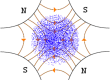
Magnetic assemblies offer greater control over magnetic field distribution. By optimizing the size, magnetization direction, and arrangement of permanent magnets, designers can increase magnetic flux density at the intended working position. This approach can improve magnetic performance at the locking mechanism without simply increasing the size of a single magnet.
However, magnetic assemblies do not automatically outperform standalone Neodymium magnets. Their effectiveness depends on magnet geometry, working distance, magnetic circuit configuration, and the requirements of the locking mechanism. The key advantage lies in the ability to optimize magnetic performance within specific dimensional and cost constraints.
How Magnetic Circuit Design Improves Detacher Performance?
Magnetic circuit design begins with the requirements of the EAS locking mechanism. The position and movement direction of the internal locking components determine where magnetic attraction is needed. Magnet configurations can then be optimized to produce the required magnetic field at these locations, rather than simply maximizing Gauss readings at the detacher surface.
Changes in magnet spacing, polarity, and relative position can affect both magnetic flux density and field gradient. For effective release, the resulting magnetic force must act in the direction required to disengage the locking mechanisms. The magnetic arrangement should also accommodate minor variations in tag positioning and alignment.
Evaluating magnetic performance at different working distances helps determine whether a particular configuration can meet these requirements. This is particularly important when comparing designs that produce different magnetic field distributions despite using similar amounts of magnetic material.
Magnetic Flux Density vs. Distance: Standalone Magnets vs. Magnetic Assemblies
Magnetic flux density generally decreases with increasing distance from the working surfaces of magnets and magnetic assemblies. However, the rate of decrease depends on magnet geometry and magnetic field distribution.
Standalone Neodymium magnets and magnetic detacher assemblies can exhibit different characteristics, even when using the same magnet grade and overall dimensions. The following simulation compares two configurations with the same Ø38 mm diameter and height.
Magnetic assemblies can be designed to produce higher magnetic flux density within a concentrated working area. However, this advantage may change as the distance increases.

Configurations that produce stronger magnetic fields near the working surface do not necessarily maintain the same advantage at greater distances. The actual relationship depends on magnet dimensions, magnetization directions, and magnetic circuit arrangements.
Finite element analysis (FEA) allows these differences to be evaluated by comparing magnetic flux density at various distances from the working surface. Such comparisons can help identify which configurations provide more suitable magnetic field distributions for the intended working distance. However, magnetic flux density curves alone do not establish actual detaching forces, which also depend on field gradients and the characteristics of the locking components.