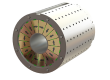
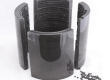
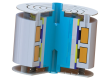
Strong magnetic fields and strong magnetic field gradients are not the same. Magnetic field strength describes the magnitude of a magnetic field at a given location, while magnetic field gradients describe how rapidly the field changes with position.
This distinction becomes important when magnetic fields are used to generate forces or create position-dependent magnetic behavior. Magnetic separation, particle manipulation, and beam focusing all make use of deliberately nonuniform magnetic fields rather than field strength alone.
Permanent magnet systems can create magnetic field gradients through magnetic circuit geometry, pole shapes, air gaps, and controlled magnetization patterns. These design variables determine not only how strong the magnetic field is, but also how it changes across the working region.
What Are Magnetic Field Gradients?
Magnetic field gradients describe how a magnetic field changes with position. In a simplified one-dimensional case, the gradient can be expressed as:

where B is the magnetic flux density and xx is the position along the direction being evaluated. This expression is useful for describing field variation along a selected line. In three-dimensional magnetic systems, magnetic field gradients may exist simultaneously in multiple directions.
If the magnetic flux density remains nearly constant across a working region, the gradient along that direction is close to zero and the field can be considered approximately uniform. If the magnetic flux density changes significantly over a short distance, the gradient is larger.
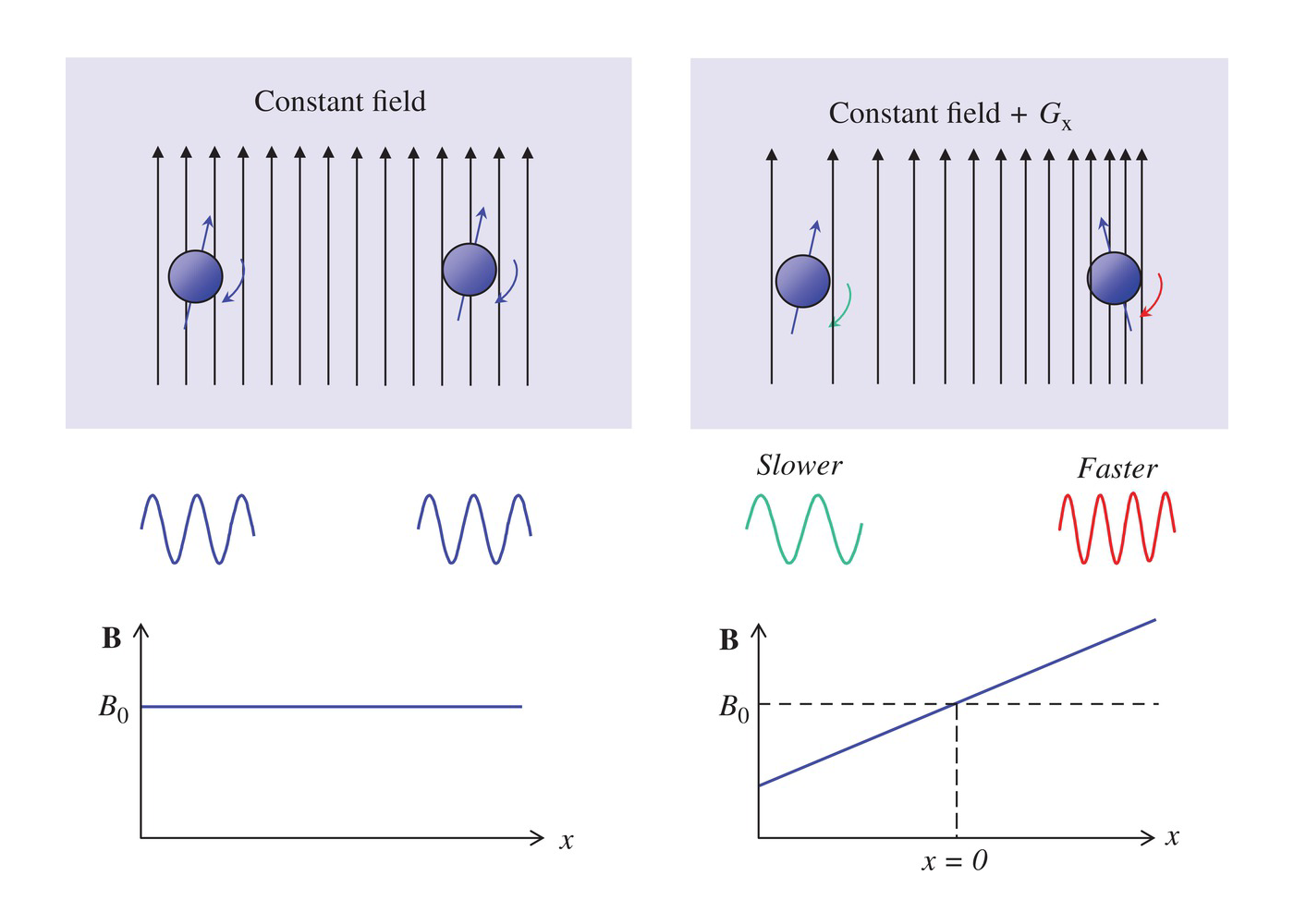
Magnetic field gradients do not have to be linear. In some magnetic systems, however, a controlled linear gradient is deliberately created so that the magnetic field changes predictably with position. Permanent magnet quadrupoles are a typical example: the field approaches zero at the center and increases approximately linearly with distance from that center.
The important distinction is that magnetic field gradients describe spatial variation rather than magnetic field strength alone. A region with a high magnetic flux density can still have a relatively small gradient, while a lower-field region can have a much steeper gradient.
Magnetic Field Strength vs. Magnetic Field Gradient
A high magnetic flux density does not necessarily indicate a large magnetic field gradient. If the field remains relatively constant across a working region, the gradient can remain small even when the magnetic flux density is high. Conversely, a lower magnetic flux density can be associated with a steep gradient if the field changes rapidly over a short distance.
This distinction becomes especially important when magnetic fields are used to generate forces. In many permanent magnet systems, performance depends not only on the magnetic flux density at a particular point, but also on how rapidly that flux density changes around the object being acted upon.
Two permanent magnet systems may therefore produce similar magnetic flux densities at their working surfaces while creating very different field distributions away from those surfaces. Pole geometry, air gaps, magnetic circuit design, and magnet arrangement can all influence the resulting magnetic field gradient even when the peak magnetic flux densities are similar.
How Permanent Magnet Systems Create Magnetic Field Gradients?
Permanent magnets naturally produce nonuniform magnetic fields outside their surfaces, but useful magnetic field gradients are usually created by controlling how magnetic flux is distributed within a defined working region. In permanent magnet systems, this is mainly achieved through magnetic circuit geometry or through the spatial arrangement of magnetization.
Magnetic Circuit Geometry and Pole Shapes
Yokes, pole pieces, and air gaps can reshape the path of magnetic flux and concentrate it into selected regions.
Narrow pole tips, shaped pole faces, or small working gaps can cause magnetic flux density to change rapidly over a short distance, producing a steep local gradient.
The resulting gradient depends not only on the magnets themselves, but also on the geometry and magnetic properties of the surrounding ferromagnetic components. Changes in pole width, gap distance, and local saturation can significantly alter how quickly the field rises or falls across the working region.
In many designs, the highest magnetic field gradients appear near pole tips, edges, or other regions where magnetic flux is strongly concentrated.
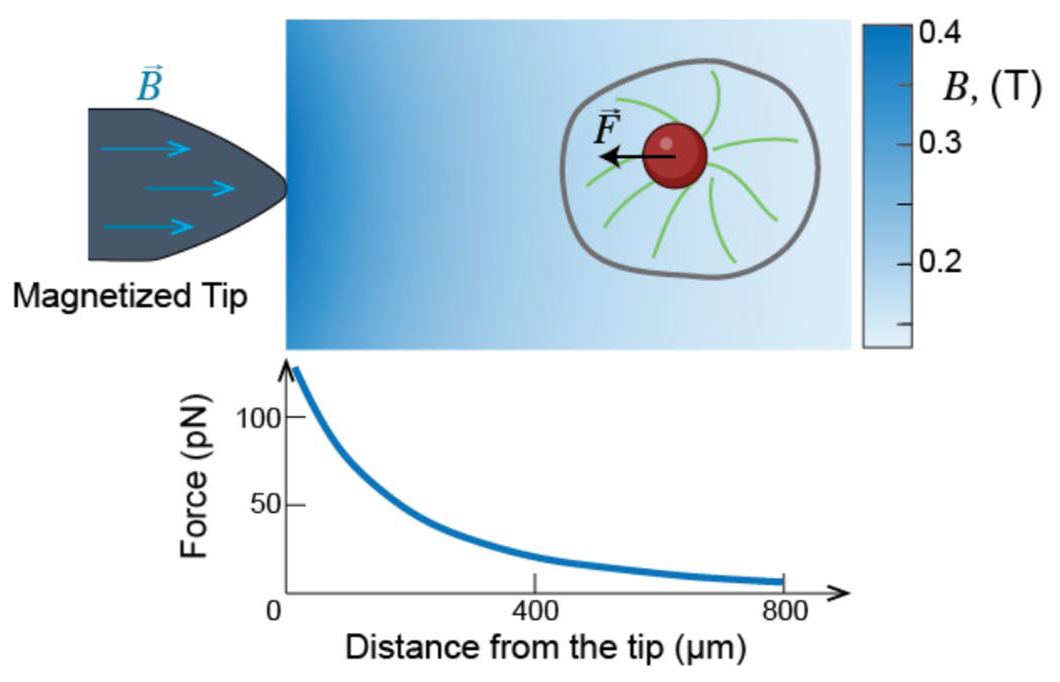
Halbach Quadrupoles and Multipole Arrays
Magnetic field gradients can also be created through controlled magnetization patterns without relying primarily on ferromagnetic pole pieces. A permanent magnet quadrupole is a typical example.
In an ideal quadrupole field, the magnetic field approaches zero at the center, while its transverse components vary approximately linearly with position. One common representation is:

where G is the magnetic field gradient. The exact signs and component directions depend on the orientation of the quadrupole.
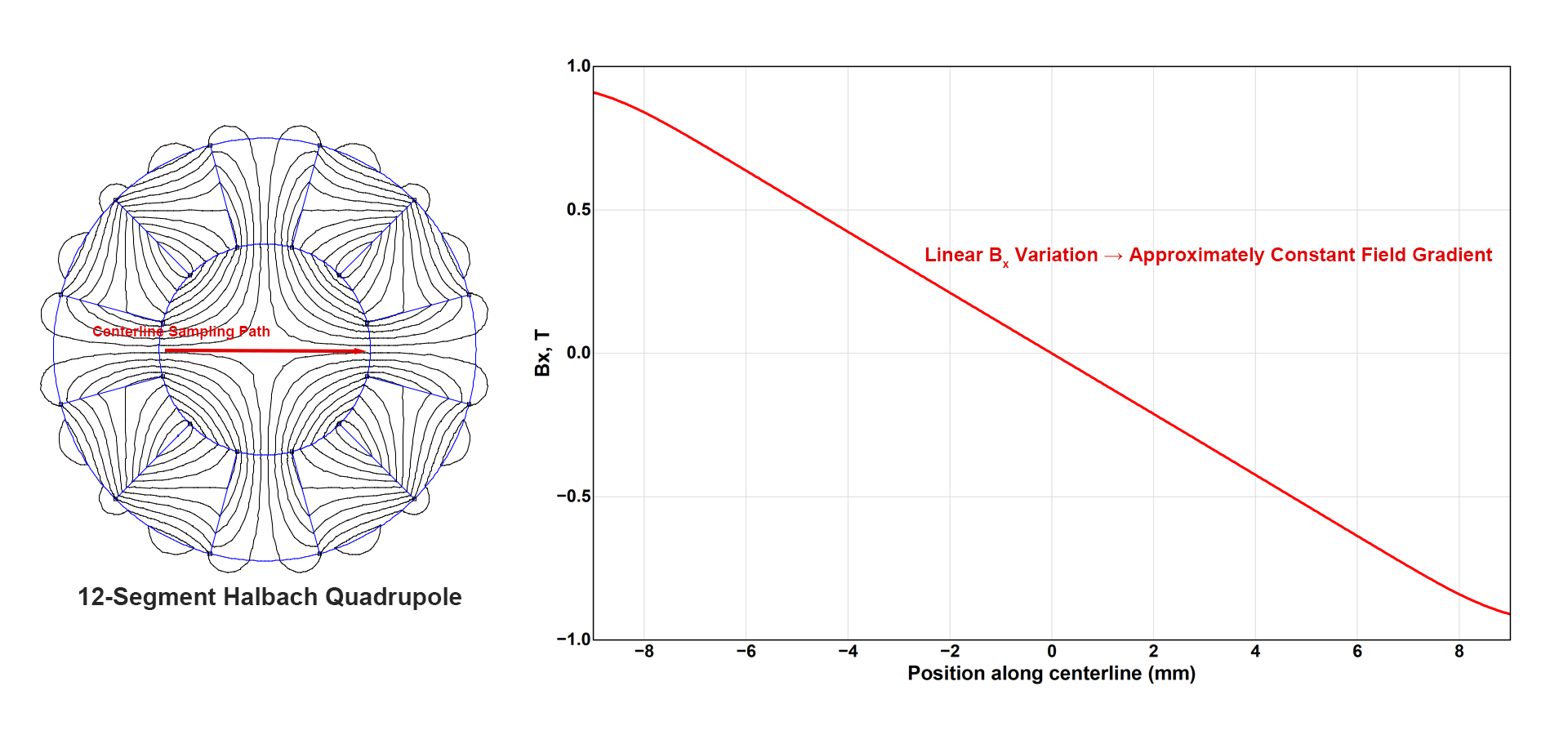
Halbach quadrupoles use a rotating magnetization pattern to approximate this field distribution. In practical segmented arrays, individual permanent magnets approximate the continuously changing magnetization of an ideal Halbach cylinder. The field remains close to linear within the central working region, while deviations become more noticeable closer to the magnet surfaces because of segmentation and local edge effects.
Higher-order multipole arrays, such as sextupoles and octupoles, create increasingly nonlinear field distributions rather than a constant linear gradient. They are generally used when more specialized spatial field control is required.
How Magnetic Field Gradients Generate Force?
Magnetic field gradients become especially important when magnetic fields are used to generate forces. Uniform magnetic fields can exert torques on magnetic dipoles, but net translational forces generally require the magnetic fields to vary with position.
For small magnetic dipoles whose magnetic moments are aligned with the local fields, the force along a selected direction can be approximated as:
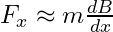
where m is the magnetic moment and dB/dx is the magnetic field gradient along that direction. Steeper gradients therefore produce larger forces for the same magnetic moment.
For magnetizable particles and materials, the relationship can be more complex because the magnetic moments themselves may depend on the applied fields. In many practical cases, magnetic forces are related to both the local magnetic flux densities and their spatial gradients. This is why systems designed for magnetic separation or particle manipulation often require a combination of sufficient magnetic field strength and strong local field gradients.
High magnetic flux densities alone do not guarantee large translational forces. If the magnetic fields change very little across the objects or particles, the forces acting on different regions can largely balance. Magnetic field gradients create the spatial imbalance needed to produce directional motion.
Applications of Magnetic Field Gradients
Magnetic field gradients are used to generate position-dependent magnetic forces. Different applications create and use these gradients in different ways, from localized flux concentration to controlled multipole fields.
Magnetic Separation
Magnetic separators use strong local field gradients to attract and capture magnetic or magnetizable particles. Pole tips, wires, meshes, and other ferromagnetic structures are often used to concentrate magnetic flux and increase the gradient.
Particle Manipulation
Magnetic field gradients can attract, transport, concentrate, or position magnetic particles and magnetically labeled materials without direct mechanical contact.
Beam Focusing
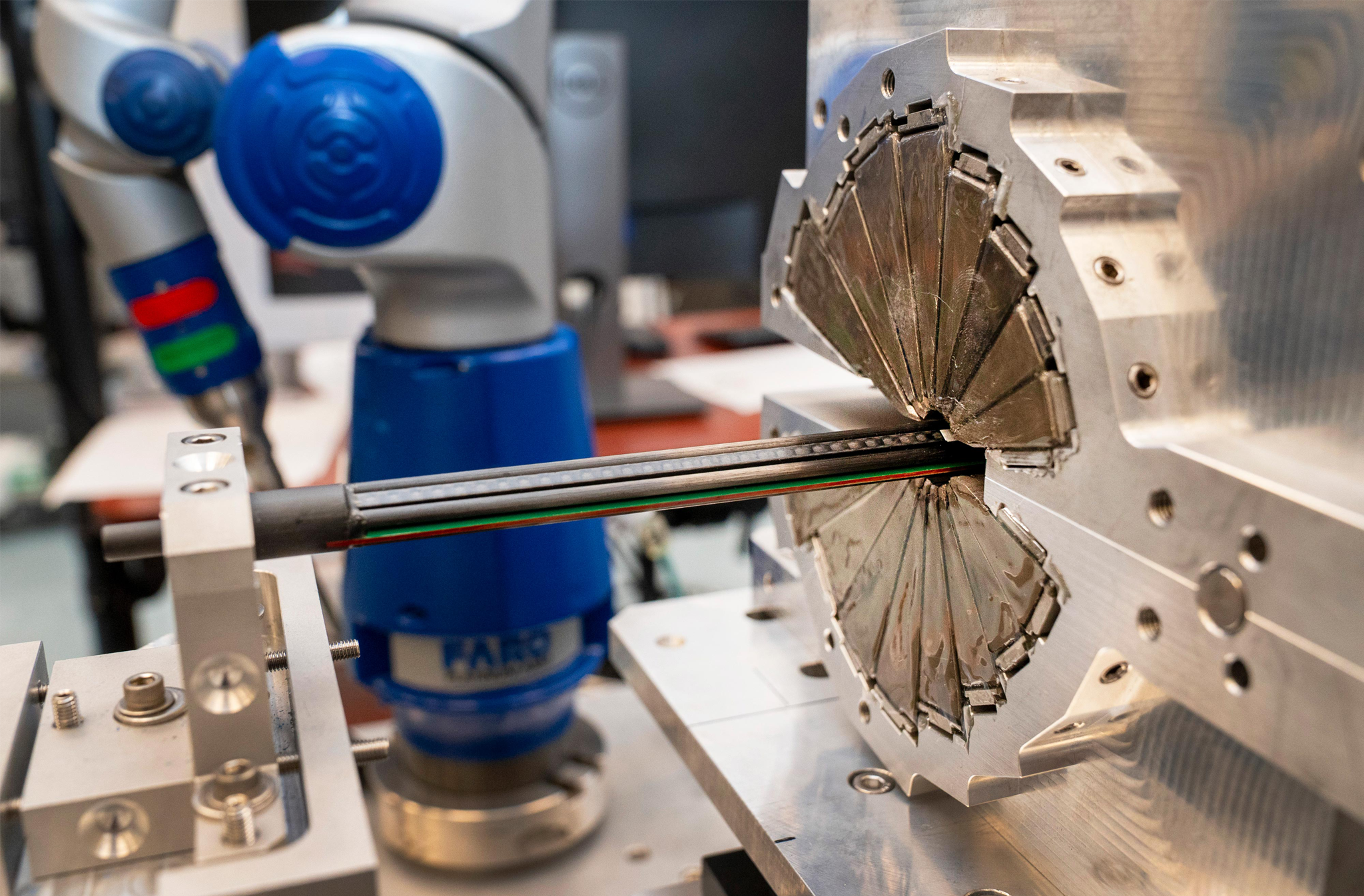
Quadrupole magnets produce approximately linear field variations around the central axis. These fields generate position-dependent forces that are widely used to focus and control charged-particle beams.

Magnetic Separation

Particle Manipulation
Beam Focusing
What Determines Magnetic Field Gradient Strength?
Magnetic field gradient strength depends on both the available magnetic flux and how rapidly that flux is redistributed across the working region. Stronger magnets can provide more magnetic flux, but magnet properties alone do not determine the resulting gradient.
Magnet Strength and Magnetic Circuit
Higher remanence can increase the magnetic flux available to the system, while yokes and other ferromagnetic components influence how efficiently that flux reaches the working region. Local saturation can limit further increases in magnetic flux concentration and gradient strength.
Air Gaps and Working Distance
Magnetic fields generally change more rapidly close to magnets, pole tips, and other flux-concentrating features. Smaller air gaps and shorter working distances can therefore produce steeper gradients, although the usable working region may also become smaller.
Pole Geometry
Pole width, pole-tip shape, edges, and other geometric features determine where magnetic flux is concentrated. Sharper or narrower features can create particularly high local gradients, while broader pole faces generally distribute the field over a larger region.
Magnet Arrangement and Segmentation
In multipole systems, gradient strength and field quality also depend on the magnetization pattern and the number of segments. Increasing the number of segments in a Halbach quadrupole allows the practical array to more closely approximate the ideal continuous magnetization pattern, although the improvement becomes progressively smaller as the segment count increases.