Ι What Are Skewed Magnets?
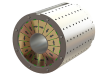
Skewed magnets are permanent magnets intentionally designed with an angular displacement in either the magnetization direction or the physical arrangement of their segments. This angular offset improves motor performance by minimizing cogging torque and and enhancing smoothness during motor operation.
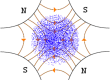
There are two primary forms of skewed magnets: skewed magnetized ring magnets and skewed arc magnets. Skewed magnetized ring magnets feature a helical or angled magnetization pattern, unlike traditional diametrically multipole magnets, where the magnetic poles are arranged in straight radial segments. In skewed ring magnets, the poles are distributed along the circumference in an angled manner, creating a more uniform magnetic flux density that reduces torque ripple and improves motor efficiency.

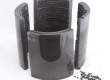
Skewed arc magnets, on the other hand, are physically designed with angular offsets between each segment. These arc magnets are machined and arranged at an angle relative to one another, creating an offset in their structure. This angular displacement alters the magnetic flux distribution, helping to reduce cogging torque and improve overall motor performance.
In the magnet industry, the term “skewed magnets” generally refers to arc magnets, where the angular offset of the segments is key to minimizing cogging torque and ensuring smooth, efficient operation.
Minimizing Cogging Torque with Rotor Skewing
Cogging torque is the periodic variation in motor torque caused by the interaction between the rotor’s magnetic poles and the stator slots. It arises due to the discrete nature of the magnetic poles and stator slots, with motors that have a high pole-to-slot ratio being more susceptible. As the rotor moves, the alignment between the poles and slots causes magnetic attraction and repulsion, resulting in uneven, jerky rotation.
Cogging torque can reduce motor efficiency, increase vibrations and noise, and cause mechanical wear. These fluctuations can also lead to unstable operation, affecting overall motor performance.
To minimize cogging torque, several strategies can be employed, primarily focusing on disrupting the alignment between the rotor’s magnetic poles and the stator slots. One effective method is rotor skewing, where the rotor poles are slightly offset at an angle, reducing the chance of alignment with the stator slots and resulting in smoother rotation.
Step skewing is one of the primary techniques for reducing cogging torque. It involves dividing the rotor into multiple segments and applying an angular displacement between them. The more segments used, the more effective the skewing, as it increases the randomness in the alignment of the poles, which in turn reduces cogging torque.
However, increasing the number of segments adds complexity to the manufacturing process, which can raise production costs and potentially reduce motor reliability.
Another technique for reducing cogging torque is the use of skewed magnets. Skewed magnets physically alter the alignment of the rotor’s magnetic poles, helping to minimize cogging. While this method can be highly effective, it may not be suitable for large dimensions. The machining precision required for larger magnets becomes more complex, making it more costly and difficult to achieve the necessary alignment.

Essential Considerations for Skewed Magnets
When selecting skewed magnets, it is crucial to consider several important factors to ensure they meet the specific requirements of the application. These considerations directly impact the motor’s overall performance, efficiency, and reliability. By paying close attention to these aspects, users can optimize motor functionality and ensure long-term durability.
- Material Options: Most skewed magnets are Neodymium (NdFeB), but they are also available in Samarium Cobalt (SmCo) and ferrite materials.
- Dimensional Precision: The angular offsets are critical factors when specifying skewed magnets, as they directly influence motor assembly and performance. Both users and magnet manufacturers must closely collaborate to confirm the design, particularly these dimensional factors, to ensure proper fit and optimal motor performance.
- Machining Process: Skewed magnets are typically produced from arc magnets that do not have angular offsets. These magnets are machined to create the necessary angular displacement, which is crucial for achieving optimal motor performance. The machining process requires precise fixtures to ensure accurate dimensions. Due to the complexity of this process, skewed magnets are generally more expensive than conventional arc magnets.
- Multipole Ring Magnets vs. Skewed Magnets: Multipole ring magnets are often perceived as a more expensive solution compared to skewed magnets, but they offer several notable advantages for improving motor performance. One key benefit is that multipole ring magnets eliminate the need for the expensive and labor-intensive process of gluing multiple magnets onto a rotor shaft or core, which helps reduce overall production costs. Additionally, multipole ring magnets prevent the issue of magnets falling off during operation, ensuring greater reliability and reducing maintenance costs. Furthermore, these magnets provide exceptional dimensional precision, which is crucial for achieving dynamic balance in motors. Ultimately, users should carefully assess their specific needs to determine which magnet type will best suit their application.