What Are Semi-Hard Magnets?
Semi-hard magnets are magnetic materials with properties between soft magnetic materials and hard magnetic materials. The word “semi-hard” does not refer to mechanical hardness. It refers to magnetic behavior, especially coercivity, remanence, hysteresis loop shape, and how the material responds after being magnetized.
Soft magnetic materials are designed to magnetize and demagnetize easily. Hard magnetic materials are often referred to as permanent magnet materials because they are designed to retain magnetization after the external magnetic field is removed. Semi-hard magnetic materials sit between these two groups. They can retain magnetization better than soft magnetic materials, but they are usually not selected simply for maximum magnetic strength.

This intermediate magnetic behavior is useful when a device needs controlled magnetic memory, repeatable hysteresis behavior, moderate magnetic retention, or a predictable response under changing magnetic fields. In these projects, the shape of the hysteresis loop, coercivity range, magnetic stability, and application behavior may be more important than simply choosing the strongest permanent magnet material.
In practice, semi-hard magnet projects are usually reviewed as material projects rather than simple magnet-shape projects. Alloy type, coercivity range, remanence, material form, heat treatment condition, magnetization method, and final working behavior all need to be checked before a semi-hard magnetic material can be properly evaluated.
Semi-Hard Magnetic Materials vs. Soft and Hard Magnetic Materials
The difference between soft, semi-hard, and hard magnetic materials is mainly related to how easily the material can be magnetized, demagnetized, or retain magnetization after the external magnetic field changes.
Soft magnetic materials have low coercivity. They are useful when magnetic flux needs to change easily, such as in cores, relays, transformers, inductors, electromagnetic devices, and magnetic shielding structures. In these applications, the material should respond quickly to an applied field and lose most of its magnetization when the field is removed.
Hard magnetic materials have much higher coercivity and are usually used as permanent magnet materials. Their purpose is to retain magnetization strongly after magnetization. This is why materials such as Neodymium (NdFeB) magnets, Samarium Cobalt (SmCo) magnets, and hard ferrite magnets are selected when stable magnetic output, holding force, or long-term magnetic retention is required.
Semi-hard magnetic materials sit between these two groups. They are not as easy to demagnetize as soft magnetic materials, but they are also not usually selected in the same way as high-performance permanent magnets. Their value often comes from controlled coercivity, remanence, hysteresis behavior, and repeatable magnetic response under specific working conditions.
This middle position makes semi-hard magnetic materials useful in devices where magnetic behavior must be controlled rather than simply maximized. In some applications, a predictable hysteresis loop, moderate magnetic retention, or controlled magnetic memory may be more important than the highest possible magnetic strength.
Why Coercivity and Hysteresis Define Semi-Hard Magnetic Behavior?
Coercivity is one of the key parameters used to separate soft, semi-hard, and hard magnetic materials. It describes how much reverse magnetic field is needed to reduce magnetization after a material has been magnetized.
Soft magnetic materials are designed for easy magnetization and demagnetization. Permanent magnet materials are designed to resist demagnetization and maintain stable magnetic output. Semi-hard magnetic materials sit between these two behaviors. They can retain part of their magnetic state after magnetization, but they are not usually selected for the highest possible magnetic strength.
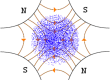
This is why the hysteresis loop is important. For semi-hard magnetic materials, the loop shape helps explain how the material behaves after magnetization, during partial demagnetization, and under repeated magnetic field changes. In many devices, this history-dependent behavior is not just a measurement result. It can directly affect torque transfer, braking force, switching action, indication, or signal response.
For this reason, semi-hard magnetic materials are not evaluated in the same way as ordinary holding magnets. Maximum surface field or maximum energy product may not describe whether the material will work correctly in the final device.
Where Semi-Hard Magnetic Materials Are Used?
Semi-hard magnetic materials are usually found in functional magnetic devices rather than simple holding applications. In these designs, the material is not selected only to create a strong magnetic field. Its magnetic state, hysteresis behavior, and response after magnetization may become part of how the device works.
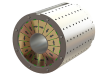
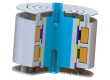
They may work together with permanent magnets, coils, moving parts, or sensing structures to create controlled torque, braking force, switching behavior, indication, or signal response. This is why semi-hard magnets are often discussed in connection with hysteresis couplings, magnetic clutches, magnetic brakes, tension control systems, sensors, switching components, magnetic indicators, security-related magnetic components, and selected functional magnetic parts.
In these applications, the material is usually evaluated by working behavior, magnetic stability, and device response, not only by size, grade name, or surface magnetic field.
Material Names and Brand References in Semi-Hard Magnets
Semi-hard magnet inquiries may use different types of material names. Some projects refer to general alloy families, such as FeCrCo, CoFeV, CoFeNi, Cunife, Vicalloy, or other semi-hard magnetic alloys. Other projects may refer to legacy material names, supplier-specific grades, or brand references used in older drawings, catalogs, or device specifications.
Names such as CROVAC, MAGNETOFLEX, VACOZET, SEMIVAC, SENSORVAC, Arnokrome, Vicalloy, and Cunife may appear in semi-hard magnet discussions depending on the application and historical design background. These names should be treated carefully. They may describe a material family, a brand-specific product, a processing condition, or a reference point used by the original device designer.
For new inquiries, the name alone is usually not enough to evaluate the material. The required magnetic behavior, coercivity range, remanence, hysteresis loop, thickness, heat treatment condition, material form, magnetization method, and working function are usually more important than the name itself.
This is especially true when a drawing or specification only lists an old material reference. In that case, the practical question is not only what the name means, but what magnetic behavior the final part must deliver in the device.
If your project involves a semi-hard magnet, a legacy material name, or a brand reference that is difficult to match directly, please send us the drawing, material specification, application background, and any available magnetic requirements. We can help review the information and discuss whether the project is suitable for further material evaluation.