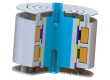
What Are PTFE Encased Magnets?
PTFE encased magnets, also described as PTFE encapsulated magnets, are permanent magnets or magnetic assemblies enclosed within formed Polytetrafluoroethylene (PTFE) structures rather than protected only by thin surface layers.
Depending on the component geometry and manufacturing route, the PTFE may form molded bodies, tubes, sleeves, machined housings, or welded enclosures around the internal magnets.
The PTFE structure separates the magnets from surrounding liquids, chemicals, slurries, or other process media while providing a chemically resistant and low-friction external surface. This makes PTFE encasement useful where corrosion protection, product cleanliness, repeated cleaning, or reduced surface adhesion is required.

Because the PTFE becomes part of the finished components, its wall thickness, joints, end closures, and external dimensions can affect the magnetic working distance, available internal space, and structural integrity. The appropriate construction therefore depends on the working medium, temperature, pressure, mechanical wear, cleaning conditions, and required sealing or inspection standards.
PTFE Encased Magnets vs. PTFE Coated Magnets
PTFE coated magnets have comparatively thin PTFE-based layers applied directly to the magnet surfaces. The coatings can provide chemical resistance, low friction, and cleaner external surfaces while causing relatively little change to the original dimensions or magnetic working distance.
PTFE encased magnets place the magnets or magnetic assemblies inside formed PTFE structures, such as molded bodies, tubes, sleeves, machined housings, or welded enclosures. This provides a more structural separation between the magnetic cores and the working media, but the additional PTFE thickness also increases the external dimensions and the distance between the magnets and the target surfaces.
Neither route is suitable for every project. PTFE coatings may be more practical when compact dimensions and magnetic output close to the magnet surfaces are priorities. PTFE encasement may be considered when the magnets require stronger isolation from liquids, chemicals, slurries, repeated cleaning, or mechanical contact. The final choice depends on the required protection level, available space, magnetic working distance, expected wear, and inspection requirements.
Common Forms and Manufacturing Routes
PTFE encased magnets can be produced from separately manufactured PTFE parts or by forming PTFE around compatible magnetic cores. The appropriate route depends on the component geometry, required wall thickness, production volume, magnetic material, and whether the magnetic core can tolerate the temperatures involved in PTFE processing.
Welded PTFE Encased Magnets
Welded constructions are commonly used for PTFE magnetic tubes, rods, and other elongated magnetic assemblies. The internal magnets and magnetic circuit are placed inside a PTFE tube or machined housing, after which PTFE end caps or closures are joined to the main body.
Hot-air welding or hot-press welding may be used to close the assembly and create a continuous PTFE exterior. This route allows the magnetic assembly to be completed before final closure and is particularly suitable for long components that would be difficult to produce as single compression-molded bodies. The resulting protection depends on the joint design, welding control, wall thickness, and inspection of the finished enclosure.
Compression-Molded PTFE Encased Magnets
Compression molding is commonly used for compact PTFE encased magnets, such as magnetic stirring bars, sensing rings, and other components that require continuous PTFE surfaces without separately welded end caps.
PTFE powder is placed in a die and compacted under pressure to produce a preform. The preform is subsequently sintered so that the PTFE particles consolidate into the finished structure.
For suitable designs, the PTFE may be formed directly around magnetic cores that can withstand the molding and sintering cycle. The magnetic material, magnetization state, and manufacturing sequence must therefore be considered before production.
Dimensional changes during sintering and the required PTFE thickness also need to be considered. The finished components still require appropriate dimensional and enclosure-integrity inspection.

Designing Custom PTFE Encased Magnets
Custom PTFE encased magnets must balance protective structure with magnetic performance. Increasing the PTFE wall thickness may improve mechanical allowance and separation from the working medium, but it also increases the magnetic working distance and can reduce the usable magnetic output at the external surface. The internal magnet size, arrangement, and magnetic circuit therefore need to be evaluated together with the required finished dimensions.
The component geometry also influences the manufacturing route. Elongated assemblies may be better suited to PTFE tubes, machined housings, and welded end closures, while compact components may use compression-molded PTFE structures. Joint positions, end-cap designs, dimensional tolerances, and the space required for internal assembly all affect the final construction.
Material and operating conditions should be defined before production. The selection of magnetic materials and manufacturing sequences depends on the processing temperature, working temperature, surrounding media, pressure, repeated cleaning, mechanical wear, and expected service conditions. Where enclosure integrity is critical, the required inspection or leakage-testing method should also be agreed in advance rather than assumed from the use of PTFE alone.
For custom PTFE encased magnets, SDM can evaluate the magnetic core, PTFE structure, wall thickness, manufacturing route, and inspection requirements as one assembly. Drawings, required magnetic performance, working media, temperature range, dimensional tolerances, and sealing expectations help determine whether welded or compression-molded constructions are more appropriate for the project.