How Does a Magnetic Oil Drain Plug Work?
Magnetic oil drain plugs combine conventional drain-plug bodies with permanent magnets positioned at their oil-exposed ends. The operating principle of a magnetic oil drain plug is simple: as oil circulates through engines, gearboxes, or differentials, normal wear can release small ferromagnetic particles from gears, bearings, shafts, and other steel components. When these particles pass close enough to the magnets, they are attracted toward their surfaces and remain attached to the plugs.
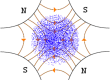
The capture effect depends on the magnetic fields around the exposed ends, especially the field gradients close to the magnet surfaces. Magnetic drain plugs do not pull metal particles uniformly from the entire oil volume; their effective capture range is relatively local. Oil movement repeatedly carries suspended debris through the surrounding regions, allowing some ferromagnetic particles to accumulate on the magnets over time.

Magnetic oil drain plugs only act on particles that respond strongly to magnetic fields. Wear debris from aluminum, copper, and many non-ferromagnetic materials will not be captured in the same way. For this reason, magnetic drain plugs are best considered supplementary debris-collection features rather than replacements for normal oil filtration systems.
What Determines Metal Debris Capture Performance?
The ability of magnetic drain plugs to capture wear debris depends on more than the maximum surface flux density of their magnets. Magnetic flux density decreases rapidly with distance, so particles passing close to the magnet surfaces are exposed to much higher magnetic flux densities than particles farther away.
Magnetic field gradient is also important because magnetic particles experience a force toward regions where the magnetic field is stronger.
Magnet dimensions and geometry therefore affect not only the measured surface flux density but also how the magnetic flux density varies with distance around the plugs. Two magnets with similar surface readings can produce different field distributions and effective capture ranges.
The debris itself is another variable. Ferromagnetic particles with different sizes, shapes, and magnetic properties respond differently to the same field, while oil movement determines how closely and how often suspended particles pass the magnets. Plug location also matters because a magnet positioned outside the main oil-flow path may encounter fewer suspended particles than one exposed to more continuous oil movement.

As captured debris accumulates, the resulting cluster of particles can also change the local magnetic field and the available collection surface.
For this reason, a specification such as “5,000 Gauss” describes only a magnetic flux density measured under particular conditions. It does not, by itself, define how effectively a magnetic oil drain plug will capture wear debris in an operating system.
Magnet Materials Used in Magnetic Drain Plugs
Neodymium (NdFeB) magnets are widely used in magnetic oil drain plugs because their high magnetic strength allows relatively small magnets to generate strong local fields near the plug ends. Many aftermarket products use high-temperature Neodymium grades rather than standard grades, since engine oil and transmission environments can expose the magnets to elevated operating temperatures. The specific grade should still be matched to the expected operating temperature rather than selected only for higher room-temperature magnetic performance.
AlNiCo magnets are also used in some magnetic drain plugs, particularly in applications where higher operating temperatures are expected. Their magnetic energy density is much lower than that of Neodymium magnets, but their strong temperature stability can make them practical when larger magnet dimensions are acceptable.
Ceramic ferrite magnets have also been used in conventional and OEM drain plug designs. They provide lower magnetic strength but offer good temperature capability, corrosion resistance, and low material cost.
The appropriate magnet material therefore depends on the available space, required magnetic performance, operating temperature, and overall plug design rather than magnetic strength alone.
Do Magnetic Oil Drain Plugs Work?
Yes, but their value is supplementary rather than comprehensive. Magnetic oil drain plugs continuously collect ferromagnetic wear debris that passes sufficiently close to the magnets, helping remove some metallic particles from circulation between oil changes.
Their effectiveness still has clear limits. Aluminum, copper, and other non-ferromagnetic wear debris will not be captured in the same way, and particles outside the effective magnetic field may continue circulating. Magnetic drain plugs therefore provide an additional debris-capture point rather than a replacement for normal oil filtration or maintenance.
What Does Metal on a Magnetic Drain Plug Mean?
Metal collected on a magnetic drain plug does not automatically indicate a serious mechanical problem. A light coating of fine metallic debris can result from normal wear, particularly in gearboxes, differentials, and other systems containing gears, bearings, shafts, and other steel components.
The size, amount, and appearance of the collected debris are more useful than its presence alone. Fine metallic fuzz or paste may be consistent with gradual wear, while larger flakes, chips, or unusually heavy accumulation can be more significant and may justify further inspection.
Changes between oil services can also provide useful context. A noticeable increase in debris compared with previous inspections may indicate a change in wear conditions, although the drain plug alone cannot identify the source or severity of a mechanical problem.

Discuss Your Magnetic Drain Plug Requirements
For magnetic drain plug projects, magnet selection can be reviewed based on available space, operating temperature, required magnetic performance, and the plug structure. If you already have drawings, target dimensions, or performance requirements, you are welcome to contact us for further discussion.