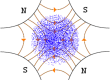
Ι What Are Magnetic Field Lines?
Magnetic field lines, also known as magnetic flux lines, are imaginary lines used to represent the magnetic field around magnets or magnetized objects. These lines illustrate both the direction and strength of the field. Their density reflects field strength: closer lines indicate stronger fields, while widely spaced lines indicate weaker ones. A tangent to any point on these lines shows the magnetic field’s direction at that point. Though not physically real, magnetic field lines are a conceptual tool that simplifies understanding of magnetic forces and interactions.
The concept was introduced by Michael Faraday, who believed reality was shaped by forces. His theory, later supported by Albert Einstein, proposed that forces like electricity and light propagate at finite speeds. Field lines can be made visible with iron filings, which align along the field, forming patterns that mirror the magnetic field’s shape.

Key Characteristics of Magnetic Field Lines
- Closed loops and continuity: Magnetic field lines always form closed and continuous loops. They originate from the north pole of a magnet, curve outward to the south pole, and then pass through the magnet’s interior to return to the north pole. This property underscores the inherent continuity of magnetic fields, distinguishing them from electric fields, which can begin or end on charges. Additionally, magnetic field lines naturally seek the path of least resistance between opposite poles, consistently forming closed loops to connect the two poles.
- Direction of magnetic field lines: Magnetic field lines have a defined direction, indicated by arrows. They flow from the north pole to the south pole outside the magnet and from the south pole to the north pole inside the magnet. While they are considered to have direction as if “flowing,” no actual movement occurs. The magnetic field and magnetic force are tangential to the field lines at any given point, representing the field’s influence in that region.
- Density of lines and field strength: The density of magnetic field lines represents the strength of the magnetic field. Closer lines indicate a stronger field, while sparse lines signify a weaker one. This is most evident near the poles, where magnetic forces are concentrated. As the distance from the poles or the magnet increases, the density of field lines decreases, reflecting the weakening of the field. The crowding of field lines provides a clear visual indicator of magnetic strength and is crucial for understanding force distribution.
- No intersection of magnetic field lines: Magnetic field lines never cross or intersect, as this would indicate conflicting directions of the magnetic field at a single point, which is physically impossible.
- Interaction with materials: Magnetic field lines bend or distort when interacting with magnetic materials, such as iron, highlighting regions of attraction or repulsion. In contrast, non-magnetic materials like wood or plastic have no effect on the field lines. Their density decreases when transitioning from a material with higher permeability to one with lower permeability, reflecting changes in the magnetic field’s behavior.
Exploring Magnetic Field Lines: From Basics to Advanced Patterns
For most people, their first experience with magnetic field lines involves observing how they travel from the north pole to the south pole of a bar magnet or a horseshoe magnet. These magnets are excellent starting points for understanding the basic principles of magnetic fields. Observing these patterns visually helps explain how magnetic forces operate.
Some common methods for visualizing magnetic field lines include:
- Simple iron filings: Sprinkled around a magnet, the filings align with the magnetic field lines, offering a simple yet effective way to observe the field’s patterns.
- Ferrofluid: This magnetic liquid forms striking spike patterns that visually represent the field’s intensity and structure in real-time.
- Magnetic field viewer with suspended iron filings: A transparent container with iron filings suspended in liquid, providing a three-dimensional view of the field lines.
- Magnetic field viewer with compass needles: A grid of small compass needles that align with the magnetic field, showing its direction and distribution.

Simple Iron Filings

Ferrofluid

Magnetic Field Viewer with Suspended Iron Filings

Magnetic Field Viewer with Compass Needles
While these tools are great for demonstrating basic magnetic field patterns, they are primarily educational and work best for simple-shaped magnets, like bar or horseshoe magnets, which have straightforward magnetization patterns.
Magnets with complex magnetization patterns create unique and intricate magnetic field distributions. Visualizing these requires more advanced tools, such as:
- Magnetic field viewer: This viewer changes color to indicate variations in the magnetic field’s intensity and direction, offering an intuitive visual representation.
- Gauss meters: While not visual tools, Gauss meters are essential for measuring the magnetic field’s strength at specific points, complementing visual methods with quantitative data.
- 3D magnetic field camera: A sophisticated tool that captures high-resolution 3D images of magnetic fields, providing detailed insights into their strength, direction, and distribution. It complements traditional methods with advanced imaging and scanning capabilities.


For even more complex cases, such as analyzing advanced magnetization patterns, simulation software becomes invaluable. It enables precise modeling of magnetic fields in intricate systems, offering insights that physical tools cannot achieve. These simulations help visualize different magnetization patterns, each creating distinct and intricate magnetic field line distributions:

Axially Magnetized Cylindrical Magnet

Axially Magnetized Ring Magnet

Sphere Magnet

Single-Plane Axially Multipole Disc Magnet

Double-Plane Axially Multipole Disc Magnet

Single-Plane Axially Multipole Ring Magnet

Double-Plane Axially Multipole Ring Magnet

Diametrically Magnetized Cylindrical Magnet

Diametrically Magnetized Ring Magnet

Diametrically Magnetized Arc Magnet

Diametrically Multipole Ring Magnet with Outside Diameter Magnetized
Diametrically Multipole Ring Magnet with Inside Diameter Magnetized

Radially Magnetized Ring Magnet
Practical Applications and Importance of Magnetic Flux Lines in Design
Magnetic flux lines are a vital tool for visualizing and understanding magnetic fields. They provide insight into the direction and strength of magnetic forces, enabling engineers to analyze how magnets interact with their surroundings. By examining the distribution of flux lines, designers can optimize the performance of magnetic components, enhance system efficiency, and address potential design challenges. This conceptual framework bridges the gap between theoretical magnetic principles and real-world applications, forming the foundation for innovations in modern technology and engineering.