Ι What Is Magnetic Fastening Cord?
Magnetic fastening cord—also referred to as magnetic closure cord—is a specialized magnetic trim developed specifically for functional closures in apparel and bags. It serves as an alternative to buttons, zippers, or Velcro, offering a more intuitive interaction.
By encapsulating Neodymium (NdFeB) magnets within a flexible, waterproof polymer casing, it enables a continuous, invisible, and self-aligning closure. Designed to be embedded within fabrics and leather, this trim is suitable for applications such as collars, pockets, and bag openings.
To facilitate seamless manufacturing, the cord is designed for direct insertion into seam allowances or dedicated piping channels. Its robust construction ensures consistent magnetic flux even after repetitive laundering, providing a reliable fastening solution for technical outerwear and performance luggage.

Magnetic Alignment & Interaction Logic of Magnetic Closure Cord
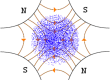
The core interaction of magnetic fastening cord is based on the serialized arrangement of internal Neodymium rod magnets. Unlike traditional single-point magnetic snaps, these diametrically magnetized magnets are positioned in a specific polar sequence to form a continuous magnetic closure loop across long joint surfaces.
This design ensures that when apparel or bag openings are brought together, the magnetic force guides the surfaces to automatically self-align and achieve instantaneous locking. Since the magnetic force is distributed linearly along the cord, it effectively avoids fabric puckering often caused by traditional fasteners, providing stable closure strength alongside a smooth, tactile opening and closing experience.


Material Stability and Environmental Durability in Practical Use
The reliability of magnetic fastening cord in apparel and bag environments stems from its composite encapsulation structure. Internal Neodymium magnets are fully enclosed within a flexible and waterproof polymer casing, creating a physical barrier that effectively prevents corrosion during laundering or in humid conditions.
The selection of the casing material balances flexibility with structural strength, ensuring the cord maintains physical integrity after frequent bending or repetitive interactions. Furthermore, the material remains stable under common temperature fluctuations; it withstands standard wash cycles and maintains consistent magnetic performance in both high-heat summer and cold winter outdoor applications.
Integration and Sewing Guidance for Magnetic Fastening Cord
To achieve the desired invisible effect when embedded within fabrics and leather, specific production techniques are required. We recommend positioning the magnetic fastening cord within dedicated piping channels or seam allowances.
During the assembly process, sewing paths must be carefully aligned to avoid the Neodymium magnets, as direct contact will lead to needle breakage. For applications involving long segments, bar-tacking the cord at both ends is necessary to prevent the magnets from shifting within the polymer casing.
Ironing and pressing require special care; direct heat contact should be avoided as high temperatures can damage the polymer casing or affect magnetic performance. We recommend using a pressing cloth or maintaining a low-heat setting during the finishing stages to protect the cord’s integrity. When working with leather, the groove depth must be adjusted according to the material thickness to ensure the magnetic force effectively penetrates the surface while maintaining reliable closure strength.

Compatibility & Interference Considerations
The magnetic circuit effectively contains the magnetic flux within a narrow path, reducing potential interference with electronics or magnetic cards. This focused field keeps the magnetic force localized, ensuring safer integration for various functional apparel and bag designs in daily use.
When using various fabrics and leather, selecting the right magnet strength is essential for optimal closure. For designs near sensitive components, increasing the lining thickness or physical spacing further improves compatibility while ensuring the fastening system performs as expected for users.