Ι What Is Magnetic Bead Separation Rack?
Fundamentally, magnetic bead separation rack is a laboratory instrument designed for the precise isolation of biological samples through high-intensity magnetic fields. Its core mission is to work in tandem with superparamagnetic beads to rapidly extract target substances—such as DNA, RNA, proteins, or specific cells—from complex mixtures. Unlike traditional centrifugation or filtration, the magnetic separation process is gentler and easily adaptable for high-throughput automation, making it a critical infrastructure in modern molecular diagnostics (IVD) and life science research.
Standard separation rack typically consists of two primary components: permanent magnets and the non-magnetic housing. Permanent magnets are usually made of Neodymium (NdFeB), which serves as the source of capture force. Meanwhile, the housing is precision-engineered to ensure that laboratory vessels fit perfectly against the magnets at the optimal distance.

From magnetics industry perspective, magnetic bead separation rack is far more than just housing with few magnets; it is micro-magnetic capture system. In this system, magnet grade determines magnitude of force, while magnet geometry dictates distribution of magnetic flux lines within vessel. This distribution directly influences travel path of beads in liquid and final shape of pellet formed on tube wall.
Understanding this is crucial. In biological applications, we do not just need beads to move; we require them to converge at predetermined location in shortest time and in most compact manner possible. This ensures that during subsequent supernatant removal, no precious biological sample is lost.
Principle of Magnetic Bead: Structure and Function
Magnetic bead is microsphere carrier with specific magnetism and structure fabricated by combination of superparamagnetic particles and organic polymer. Outermost layer of magnetic bead consists of functional groups that exhibit different physical properties depending on group type (e.g., –OH, -COOH, -CHO, -NH2, -SH, -CONO2, -CONH2), including hydrophobic-hydrophilic, polar-nonpolar, and positive charge-negative charge characteristics. Therefore, magnetic bead can combine with various ligands based on these physical properties, such as antibodies, antigens, DNA, and RNA. Furthermore, magnetic bead demonstrates magnetic response when subjected to external magnetic field. This magnetic responsiveness allows magnetic bead separation rack to effectively manipulate particles during purification processes.

Physics of Magnetic Bead Separation: Force and Gradient
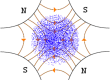
Efficiency of magnetic bead separation rack is determined by complex interplay between magnetic forces and fluid dynamics. Most biological separation protocols utilize superparamagnetic beads, which are unique because they become magnetized in presence of external field but return to non-magnetic state once field is removed. This characteristic prevents beads from clumping together permanently, allowing for easy resuspension during washing steps. When laboratory vessel is placed into rack, permanent magnets generate field that penetrates solution and induces magnetic moment in each bead, effectively turning every microscopic particle into tiny magnet that is drawn toward source of field.
However, common misconception is that magnetic flux density (B) alone is responsible for pulling beads. In reality, driving force behind movement is magnetic field gradient (∇B), which represents rate of change in magnetic strength over distance. Magnetic force (Fm) acting on single bead can be expressed by equation Fm = (m · ∇)B. This physical law dictates that in perfectly uniform magnetic field, bead would experience no net translational force and would simply spin in place. For separation to occur, rack must be designed to create sharp gradient in field, which generates mechanical pull necessary to move beads through liquid buffer.
As beads accelerate toward magnet, they must overcome hydrodynamic drag of liquid, resistance that increases with speed of bead and viscosity of sample. This is where magnet geometry becomes critical. By using specific magnet shapes, rack projects steep gradient deep into solution. This ensures that even beads located on far side of container experience force strong enough to overcome drag and reach vessel wall. Once beads are captured, continued presence of gradient holds them in tight pellet, allowing researcher to remove supernatant without disturbing target DNA, RNA, or protein samples.
Magnet Placement and Configurations in Magnetic Bead Separation Rack
Placement of magnets within magnetic bead separation rack is primarily determined by vessel type and desired collection point. For individual tubes, disc magnets are frequently embedded into side of housing. This lateral arrangement pulls beads toward side wall, which is particularly useful for manual pipetting as it keeps pellet away from bottom of tube. Size and thickness of these side-mounted magnets are usually chosen to match liquid level in tube, ensuring that beads are captured regardless of sample volume.
For multi-well plates, configurations often involve magnets located at bottom. Some models, like those seen in 96-well plate separators, utilize array of small cylindrical magnets that fit between wells to pull beads toward side-bottom area. Others use flat block magnets positioned directly underneath plate for centralized collection at bottom of each well. These bottom-mounted designs are standard for high-throughput automation, where robotic arms require consistent and predictable pellet locations across hundreds of wells simultaneously.
Specifications for magnetic bead separation rack must align perfectly with dimensions of laboratory vessels. Since even minor air gaps between magnet and container can significantly reduce capture efficiency, housing is often custom-contoured for specific brands or sizes of tubes and plates. Whether dealing with single centrifuge tubes or complex microplates, selecting right specification ensures that magnetic force is maximized at point of contact. This variety in design allows researchers to find magnetic bead separation rack that fits their specific laboratory workflow and container requirements.