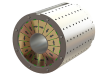
The debut of Niron Magnetics’ motor prototypes—developed in partnership with Matter at CES 2026—has once again placed Iron Nitride magnets in the global spotlight.
The timing of this resurgence is no coincidence. Following the stricter Rare Earth Export Control Regulations implemented in 2025, the global supply chain is actively hunting for a “Plan B.” With the promise of high magnetic flux density independent of the volatile rare-earth market, it is easy to see why Niron’s “Clean Earth Magnet™” is generating such excitement.
However, this sense of anticipation feels strikingly familiar. It brings us back to Elon Musk’s 2023 Investor Day, where Tesla announced a next-generation permanent magnet motor that would eliminate rare earths entirely. At that time, industry speculation ran wild: was it a return to ferrite, or a breakthrough in new materials like Iron Nitride magnets?
Now, as the conversation cycles back to this material, engineers and sourcing managers are asking the same critical question: is this technology finally ready for mass production, or is it still just a laboratory breakthrough?

What Are Iron Nitride Magnets?
At its core, the excitement surrounds a specific crystal structure known as the α”-Fe16N2 phase.
Scientifically, this material is unique because it theoretically possesses not only giant saturation magnetization (Js) but also significant magnetocrystalline anisotropy. This combination is the key requirement for making a high-performance permanent magnet. As a result, α”–Fe16N2 is widely considered a leading candidate for the next generation of high maximum energy product (BH)max magnets.
Because it derives these properties entirely from abundant Iron and Nitrogen, it has earned the title of the ultimate “rare earth-free” magnet solution.

However, understanding the reality of this material requires looking at its fundamental stability.
Looking at the Iron-Nitrogen (Fe-N) phase diagram above brings back some personal memories.
Back in 2011, I first read about the potential of Iron Nitride magnets in research reports from Tohoku University. Inspired by these early breakthroughs in Japan, I spent time in the lab attempting to synthesize Iron Nitride powder via mechanical alloying (ball milling) under a nitrogen atmosphere. Later, I closely followed the patent filings by Toda Kogyo, tracking their progress in powder synthesis.
What I learned through those experiences—and what remains a fundamental law of physics today—is that the α”-Fe16N2 phase is metastable.
Unlike the stable compounds found in sintered Neodymium (NdFeB) or ferrite, this phase doesn’t have a comfortable “home” on the equilibrium phase diagram. It has a natural tendency to decompose back into ordinary Iron α–Fe and Nitrogen gas when exposed to heat. This “metastability” is the elephant in the room. Making a few grams of powder in a controlled lab environment is one thing; maintaining phase purity during industrial-scale molding—where heat and pressure are inevitable—is a completely different engineering challenge.
The Missing Curves of Iron Nitride Magnets
It is important to clarify the current landscape. While academic circles have seen success with Iron Nitride thin films for decades, producing bulk Iron Nitride magnets is a vastly different challenge. Currently, Niron Magnetics appears to be the sole player attempting to commercialize this technology for bulk applications.
However, for the wider market to adopt Iron Nitride magnets, marketing claims are not enough. There is a growing demand among industry professionals for one critical piece of evidence: detailed magnetic properties.
Specifically, the industry is waiting to see the full demagnetization curves.
This lack of public data raises technical questions regarding the material’s coercivity Hcj. Historically, pure Iron Nitride phases are known to offer high remanence Br—similar to AlNiCo magnets—but stabilizing high coercivity in a bulk magnet has always been the primary hurdle.
Until detailed magnetic properties are released, it remains difficult for engineers to simulate these materials or consider them as a direct drop-in replacement for existing commercial solutions.
Conclusion
It is understandable why Niron Magnetics has attracted significant attention and investment from major industry players. In an era of tightening export controls and supply chain volatility, the concept of a high-performance, rare-earth-free magnet represents a vital strategic hedge. The industry is not just investing in a material; it is investing in the possibility of a diversified future.
However, from a manufacturing perspective, strategic potential does not automatically translate into immediate industrial readiness.
Based on the lessons learned from decades of materials research, the transition from lab-scale synthesis to mass production is rarely linear. Until the challenges of thermal stability are fully resolved and transparent detailed magnetic properties are available to verify performance, Iron Nitride Magnets are best viewed as a high-potential development to watch, rather than a commodity ready for the assembly line.
As manufacturers and engineers, we welcome this innovation. But for now, we remain cautiously optimistic observers.