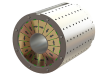
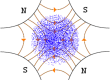
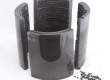
In recent years, high-speed rotor magnets in China have typically referred specifically to Neodymium magnets or magnetic rotor assemblies of high-speed motors used in high-speed hair dryers. In the late 19th century, the hair dryer was invented as a reverse application of the vacuum cleaner, aimed at quickly drying wet hair. Over the past century, while hair dryers have evolved to become more compact and ergonomically designed, their fundamental principle has remained unchanged: drying through hot air. This means that heated air continuously blows over wet hair, causing moisture to evaporate gradually. However, this drying method has significant drawbacks for those with long hair. Since moisture doesn’t evaporate uniformly, the process takes a long time. Some parts of the hair may already be dry but still need to be exposed to hot air for an extended period, leading to static electricity or causing the hair to become dry and brittle, like straw. As a result, many people with long hair prefer to leave their hair slightly damp after washing and let it air-dry naturally.

For people prone to dandruff, the traditional drying method is even less friendly. Over-drying can lead to increased dandruff, while insufficient drying may lead to catching a cold, making it challenging to strike the right balance.
In 2016, Dyson redefined high-speed hair dryers with a motor capable of reaching 110,000 RPM, leaving traditional hair dryer brands far behind. Compared to conventional hair dryers, Dyson’s high-speed hair dryer brought three major breakthroughs. First, the hair dryer uses a high-speed motor as its core component, which dries hair with increased airflow rather than relying solely on high heat. This helps preserve keratin and other nutrients in the hair, reducing hair damage. Second, the motor is smaller and lighter, allowing for a more refined design that meets consumers’ desire for aesthetically pleasing products. Traditional salon AC hair dryers had motors weighing between 260 to 300 grams, making prolonged use tiring, but Dyson’s design significantly improves user comfort. Third, the high-speed hair dryer has a longer lifespan, with product usage ranging from 1,000 to 2,000 hours, thus saving on long-term costs.
The core technology of high-speed hair dryers is the high-speed motor, with the high-speed rotor magnets being its key component. To achieve high-speed operation, the rotor magnets require extremely high precision in terms of concentricity and roundness, making it difficult to manufacture and leading to low yields. As a result, the unit price and profit margin of these magnets were very high at the time.
In recent years, Dyson has seemed to lack groundbreaking innovations. Dyson believes that the current motor speed is already approaching the upper limit of household power applications, and therefore, recent R&D efforts have focused on more comprehensive areas involving force, sound, light, and electricity. Additionally, Dyson’s founder, James Dyson, has admitted that Dyson is essentially a “slow company”—one that values long-lasting, iconic products over short-term market performance, adhering to a product philosophy of “identifying and solving pain points in everyday items.” Dyson also takes into account user habits in different countries during product development, which further extends its R&D cycle.
Meanwhile, as some core patents have expired and numerous peripheral patents have been invalidated, Chinese domestic brands have quickly caught up by learning and innovating. Not only have they mastered these technologies, but they have also optimized and improved upon them in some areas. In today’s fast-paced technological environment, Dyson’s technological advantage has become less distinct. Increasingly more Chinese brands have entered the high-speed hair dryer market. The technical barriers for high-speed motors are not high, and many brands have been able to achieve independent development by increasing their R&D investments.
The mass adoption of high-speed motors has significantly lowered production costs. Previously, just the high-speed brushless motor and drive unit in a hair dryer cost more than 200 yuan, but now some high-speed hair dryers are priced below 200 yuan. Similar to MagSafe magnets, the large-scale application of high-speed motors has greatly driven advancements in magnet manufacturing technology. However, as market competition intensifies, companies have had to explore new applications to absorb excess capacity, such as handheld fans. A combination of factors has led to a sharp decline in the price and profit margin of high-speed rotor magnets. The permanent magnet industry has witnessed the progress in high-speed rotor magnets processing technology and the changes in pricing. The evolution of high-speed hair dryers from high-end to widespread use is a natural outcome of technological maturation and market competition. This widespread adoption, while it may mean losing its high-end halo, also proves its far-reaching social impact and true value—it is no longer a luxury for a select few but has become a necessity for everyday life.