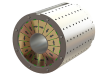
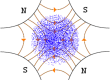
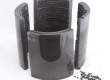
Ferrite magnet manufacturing begins with weighing and mixing raw materials, followed by pelletizing and calcination (pre-sintering). The calcined product is ground into a fine powder, pressed into shape, and sintered at high temperatures. Finally, the sintered blanks are machined and magnetized to produce the final ferrite magnets.
A critical aspect of this process is the primary raw material—iron oxide—which accounts for over 85% of the total composition. The iron oxide used in ferrite magnet production can be sourced either from iron scale or ferric oxide, with the ferric oxide typically prepared using the Ruthner process. Iron oxide is often recognized as rust by many people. With this understanding, the ferrite magnet manufacturing process can be seen as transforming rust into reliable products like motor magnets, speaker magnets, and separator magnets. For health-related applications, this transformation can even be described as turning “rust to trust.”

Permanent magnets are used in a variety of environments. Depending on the specific requirements, magnets may be used without any protection, overmolded with plastic, or encapsulated in metal. The goal is to find the right combination of magnet type and appropriate protection, such as coatings or encapsulation. Some types of permanent magnets, like Neodymium (NdFeB) and Samarium Cobalt (SmCo), have limited corrosion resistance and require additional protection based on the medium used.
A notable example is drinking water systems, which require high resistance and compatibility. In these systems, ferrite magnets are commonly found in flow meters, water meters, and pumps due to their natural resistance to corrosion and non-toxic properties, allowing them to be used in drinking water and foodstuff applications without special protection. In contrast, Neodymium magnets should be avoided in wet environments unless adequately protected, as they are prone to corrosion and may lead to potential water contamination.