Drone motor magnets have traditionally been a relatively narrow category within the permanent magnet industry. Their individual size and weight are small, and they are usually discussed as components of brushless motors rather than as a market of their own. Recent developments in both UAV manufacturing and permanent magnet supply chains, however, make them increasingly worth examining as a category in their own right.
Outside China, governments and manufacturers are investing in new rare earth magnet capacity in an effort to reduce dependence on China’s long-established dominance in high-performance permanent magnet manufacturing. Some projects have already moved from planning into production, including new capacity in Europe and the United States, while much larger facilities are still being developed. Yet establishing new magnet factories is not the same as reproducing the breadth of China’s existing supply base. New capacity outside China is more likely to gain traction first in applications where supply security carries additional value, specifications can be relatively concentrated, and individual programs are large enough to support dedicated production. Automotive traction motors are perhaps the clearest example.
Drone motors present a different but particularly interesting case. Automotive programs provide enormous and predictable volumes, but qualification cycles are long and their supply chains are already highly developed. Traditional defense programs place greater emphasis on supply security, but demand can be smaller and fragmented across many programs. Drones sit somewhere between the two. Each motor consumes only a small quantity of magnets, yet successful platforms can scale rapidly to very large production volumes. Similar motor architectures may also be reused across product families, while commercial, industrial, and defense UAVs often rely on closely related propulsion technologies. This makes drone motor magnets unusually suitable for testing whether fragmented demand can be aggregated into a viable new supply base.
The regulatory environment is evolving at the same time. China has progressively refined export controls covering drones, certain UAV-related equipment, and broader dual-use goods, with greater attention to end users and end uses. Current UAV rules also prohibit exports of otherwise uncontrolled drones when exporters know or should know that they will be used for military purposes, terrorism, or the proliferation of weapons of mass destruction. In a sector where civilian technologies can sometimes be redirected toward military applications, stronger end-use management and efforts to prevent weapons proliferation are a legitimate and important part of responsible international trade.
Despite this more complicated sourcing environment, inquiries for drone motor magnets remain active across the magnet industry. The underlying need for small, high-performance magnets has not disappeared, but sourcing them now involves more than magnetic performance and price alone. Production scalability, traceability, end-use information, origin, and supply continuity increasingly need to be considered alongside the technical requirements.
Domestic drone manufacturing also reveals the difference between final assembly and a genuinely domestic component supply chain. A UAV may be designed, assembled, or marketed as a domestic product without every layer of its upstream supply chain being domestic.

The U.S. government’s own Section 232 assessment reached a similar conclusion, noting that many UAVs produced domestically still depend heavily on foreign components such as motors, electronic speed controllers, batteries, and docking stations. Permanent magnets illustrate the same gap particularly well: they occupy very little physical space inside a drone, but establishing a genuinely non-China source requires manufacturing capabilities much further upstream.
On August 13, 2026, the United States took another step toward localizing this supply chain by announcing new Section 232 tariffs on imported drones and UAS components. The measures include tariffs of 100% on certain larger or more sensitive drones and critical components, 25% on smaller drones, and a 25% tariff on certain additional UAS components taking effect after a 180-day delay. The proclamation also authorizes an onshoring program for companies investing in new U.S. production of drones and their components. The policy therefore reaches beyond where a drone is assembled and increasingly toward where its underlying components are made.
MP Materials’ Project Swarm provides a particularly interesting experiment at the magnet level. Launched in July 2026, the initiative seeks to aggregate future rare earth magnet demand from U.S. and allied drone and motor manufacturers and reserve production capacity for that combined demand. MP describes the central problem plainly: individual drone programs may represent relatively small and specialized magnet orders, even though their combined requirements can become significant at scale. Rather than treating these programs as isolated customers, Project Swarm attempts to turn fragmented demand into a larger and more predictable production base.
In this sense, drone motor magnets are becoming a practical experiment in how a non-China magnet supply chain might be built around a selected downstream application. For motor designers and magnet buyers, however, the engineering fundamentals remain unchanged. Magnet geometry, material grade, thermal stability, manufacturing consistency, magnetization, and compatibility with the rotor design ultimately determine whether drone motor magnets will perform as required.
What Are Drone Motor Magnets?
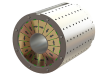
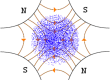
Drone motor magnets are the permanent magnets used to generate the rotor magnetic field in brushless motors for UAV propulsion. Most multirotor propulsion systems use outrunner motors, where the rotor bell rotates around the stator and the magnets are bonded to the inner circumference of the bell. Alternating magnetic poles interact with the stator field to produce torque.
High-performance drone motors commonly use Neodymium (NdFeB) magnets because their high magnetic energy density allows substantial torque to be produced from compact and lightweight motor designs.
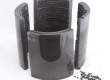
The magnets are typically arranged as individual segments around the rotor. Curved, arc-shaped, or bread-loaf geometries can follow the inner surface of the rotor more closely than simple rectangular blocks, helping control the air gap and magnetic field distribution.

Although each drone motor contains only a small amount of magnetic material, the geometry of the magnets has a direct influence on motor performance. Thickness, arc angle, length, pole count, magnetization direction, and the air gap between the rotor and stator all interact with the electromagnetic design. Magnets that fit mechanically are therefore not necessarily interchangeable with other magnets of similar external dimensions.
Material grades are equally application-dependent. Higher remanence can support greater magnetic loading, while sufficient intrinsic coercivity is needed to resist irreversible demagnetization under the combined effects of motor temperature and opposing magnetic fields. High-coercivity Neodymium magnets may be required under demanding thermal conditions, but they are not automatically necessary for every drone motor. Appropriate grades should be selected according to operating temperature, magnetic circuit design, and expected load profile rather than the UAV category alone.
For buyers sourcing drone motor magnets, motor designations by themselves rarely define the required specifications. Rotor dimensions, magnet geometry, pole configuration, material grade, coating, magnetization, and assembly requirements still need to be confirmed for each motor design.
Understanding Drone Motor Size Codes
Many FPV and small multirotor motors use size codes such as 0802, 1103, 2207, 2306, or 2806.5. These numbers generally describe the stator dimensions rather than the external dimensions of the complete motor.
In a 2207 motor, for example, “22” typically indicates a stator diameter of approximately 22 mm, while “07” refers to a stator stack height of approximately 7 mm. The same convention applies to sizes such as 2806.5, where the stator diameter is about 28 mm and the stack height is about 6.5 mm.
These codes provide a convenient way to understand the physical scale of a motor and compare different propulsion classes. Small sizes such as 0802 and 1103 are commonly associated with micro and ultralight platforms, while larger formats such as 3115 and 7015 appear in much larger propulsion systems.

As stator dimensions increase, motor torque capability, power handling, and suitable propeller size generally increase as well, although actual performance also depends on winding design, KV rating, voltage, cooling, and the overall electromagnetic design.
The naming convention is widely used in FPV and small multirotor motors, but it is not a universal standard across the entire UAV industry. Larger industrial, agricultural, and heavy-lift propulsion systems often use manufacturer-specific series names or model numbers instead.
Common Drone Motor Sizes and Typical Applications
Drone motor size codes provide a useful shorthand for comparing common propulsion classes. The table below summarizes representative motor sizes and their typical applications across micro, FPV, long-range, cinematic, industrial, and heavy-lift UAVs.
These size codes are widely used in FPV and small multirotor motors, but they are not universal across the UAV industry. Actual motor dimensions, winding configurations, KV ratings, and model naming can vary by manufacturer, so the table should be treated as a general application reference rather than a compatibility specification.
| Stator Size Group | Representative Sizes | Typical Applications |
| 08xx | 0802, 0803, 0804 | 65–75 mm whoops and ultralight micro builds |
| 10xx | 1002, 1003 | Ultralight whoops and toothpick builds |
| 11xx | 1103, 1104, 1106 | Micro FPV, whoops and toothpick builds |
| 12xx | 1202, 1204, 1207 | Micro and small FPV platforms |
| Stator Size Group | Representative Sizes | Typical Applications |
| 14xx | 1404, 1408 | 2.5–4-inch FPV, cinewhoop and racing builds |
| 15xx / 16xx | 1507, 1606 | Small performance FPV and racing builds |
| 20xx | 2004 | Ultralight 4–5-inch FPV builds |
| 22xx | 2205, 2207, 2207.5 | Common 5-inch FPV racing and freestyle platforms |
| 23xx | 2306, 2306.5 | 5-inch freestyle, racing and cinematic FPV |
| 24xx / 25xx | 2408, 2507 | 6–7-inch freestyle, long-range and cinematic FPV |
| Stator Size Group | Representative Sizes | Typical Applications |
| 28xx | 2806.5, 2807, 2810 | 7–10-inch long-range FPV and cinelifters |
| 31xx | 3110, 3112, 3115 | Large FPV, macroquads and cinelifters |
| 35xx | 3508, 3510, 3515 | Aerial photography, endurance multirotors and light industrial UAVs |
| Stator Size Group | Representative Sizes | Typical Applications |
| 41xx / 42xx | 4108, 4114, 4215 | Large FPV, aerial imaging and light industrial multirotors |
| 50xx / 52xx | 5008, 5010, 5215 | Large FPV, endurance and light/medium industrial UAVs |
| 60xx / 62xx | 6010, 6215 | Industrial, agricultural and payload-carrying multirotors |
| 70xx | 7010, 7015 | Industrial mapping, inspection, cargo and heavy-lift UAVs |
| Stator Size Group | Representative Sizes | Typical Applications |
| 81xx / 83xx | 8108, 8120, 8318 | Large industrial and agricultural multirotors |
| 90xx / 92xx | 9010, 9215, 9235 | Heavy-lift, agricultural and specialized industrial UAVs |
| 100xx | 10010, 10018, 10028, 10033 | Agricultural spraying and spreading UAVs |
| 155xx | 15516, 15522 | Very large agricultural and heavy-payload UAVs |
What May Be Next?
Drone motor magnets are not simply a hypothetical market for a future non-China supply chain. The underlying demand already exists. Many UAV programs are already in production, procurement can become time-sensitive, and relatively small quantities of magnets per motor can translate into substantial demand once production reaches scale. Project Swarm is therefore responding to an existing sourcing problem rather than trying to create demand for an emerging application.
That distinction is important when considering what may come next. Other sectors may eventually follow a similar path, but most are not yet in the same position. Robotics, industrial automation, and other emerging applications may attract policy support and supply-chain attention, yet their magnet demand is often less concentrated, less standardized, or less urgent than current UAV requirements.
Robotics is nevertheless one of the clearest areas to watch. It shares some characteristics with drones. Individual motors use relatively small magnets, but robots can contain many motors, and successful platforms could eventually create substantial repeat demand. The challenge is greater product diversity: actuator architectures, motor sizes, torque requirements, and magnet specifications remain far less standardized than in many drone propulsion platforms. If a few robotic platforms eventually reach very large production volumes, however, their magnets could become another attractive target for dedicated non-China supply chains.
Policy developments also make robotics relevant to this discussion. In the United States, robotics and industrial machinery have already come under greater supply-chain scrutiny, while foreign-produced advanced robotic devices have also attracted regulatory attention. These measures do not directly target permanent magnets, but they show how quickly an emerging technology can move from a commercial growth story into a supply-chain policy issue.
Other paths are already emerging without the same national-security argument. Apple, for example, has entered a long-term agreement with MP Materials for U.S.-produced recycled rare earth magnets for its products. In this case, a single large customer can provide the demand concentration that Project Swarm is trying to create by combining many smaller customers.
The broader pattern may therefore be more important than any single application. Non-China magnet supply chains are unlikely to develop evenly across the permanent magnet market. They may instead appear application by application, wherever policy support, large customers, concentrated specifications, or sufficient production volume can justify the additional cost of establishing a separate source.
The drone experience may be especially useful because it shows how such a supply chain can be built around demand that is already real, scalable, and time-sensitive. Future applications may reach the same point through very different routes, but Project Swarm provides an early example of how fragmented magnet demand can be turned into a more organized production base.