What Is Dial Indicator Magnetic Base?
Dial indicator magnetic base refers to a switchable magnetic holding device used to position dial indicators, test indicators, and similar measuring instruments on ferromagnetic surfaces.
It provides a stable reference point on machine tools, inspection fixtures, steel structures, and other equipment where temporary but rigid indicator positioning is required.
The same product may also be described using terms such as magnetic base, dial indicator mag base, or magnetic indicator base.
When the base is combined with a column, articulated arm, flexible arm, or indicator holder, the complete assembly is often referred to as a magnetic stand. Fine-adjustment mechanisms can also be added to provide more precise control over the final indicator position.

Unlike a fixed mounting bracket, the magnetic base can be attached, repositioned, and released without drilling or mechanical fastening. Its holding function is provided by a permanent magnet and an internal magnetic circuit that can be switched between working and release positions. This switchable magnetic circuit is what allows the base to remain compact while providing strong attachment to suitable steel surfaces.
What Is Inside Dial Indicator Magnetic Base?
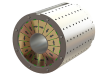
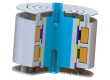
Inside a typical dial indicator magnetic base, the main magnetic components include a permanent magnet, ferromagnetic pole pieces, nonmagnetic separators, and a mechanical switching mechanism. These components are enclosed within a rigid housing that also provides the working contact surfaces.
The permanent magnet is commonly arranged so that its magnetic orientation can be changed relative to the surrounding pole pieces. Steel pole pieces provide low-reluctance paths for magnetic flux, while nonmagnetic separators help keep different sections of the magnetic circuit separated where required.
The external ON/OFF lever is connected to the internal switching mechanism. Rotating the lever changes the position of the magnetic assembly relative to the surrounding magnetic circuit, allowing the same permanent magnet to support either the holding or release condition described above.
Exact internal construction can vary between magnetic base designs, including the shape of the magnet, pole arrangement, housing structure, and working surfaces. Some bases also use V-shaped contact surfaces to provide more stable attachment to cylindrical ferromagnetic parts.
How Does Dial Indicator Magnetic Base Work?
Dial indicator magnetic base operation relies on a permanent magnet together with a switchable magnetic circuit.
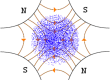
Turning the control lever does not switch the permanent magnet itself on or off. Instead, it changes how the magnetic flux is directed through the base.
In the ON position, the internal magnetic circuit directs more flux toward the contact surfaces at the bottom of the base.
When these surfaces are placed against a suitable ferromagnetic workpiece, the workpiece becomes part of the magnetic circuit, allowing the flux to pass through the base and steel surface in a closed path. This produces the holding force needed to keep the magnetic stand in position.

“On” Circuit

“Off” Circuit
In the OFF position, the internal magnetic arrangement is changed so that more of the flux closes through the magnetic circuit inside the base rather than through the external workpiece. The magnetic field at the contact surfaces is therefore greatly reduced, allowing the base to be removed or repositioned more easily.
The exact switching arrangement can vary between magnetic base designs, but the basic principle remains the same: holding force is controlled by redirecting magnetic flux rather than by magnetizing and demagnetizing the permanent magnet.
What Determines Magnetic Base Holding Force?
Magnetic base holding force depends on both the internal magnetic circuit and the conditions at the contact surface. Magnet strength, pole geometry, steel components, and the available contact area all influence how much useful magnetic flux can pass through the base and into the workpiece.
Surface condition is equally important. Paint, rust, chips, surface roughness, or even a small air gap can significantly increase magnetic reluctance and reduce holding force. Thin steel sections may also limit the amount of magnetic flux that can be carried through the external magnetic circuit.
The material and geometry of the workpiece also affect performance. A flat, thick, low-carbon steel surface generally provides more favorable magnetic conditions than thin sections, small contact areas, or curved surfaces with incomplete contact.

Published holding force values are typically measured under favorable pull-off conditions. Actual stability can be lower when the magnetic stand is subjected to side loads, vibration, long arm extensions, or torque from the indicator assembly. For this reason, rated holding force should not be treated as the allowable working load in every setup.
Where Are Dial Indicator Magnetic Bases Used?
Dial indicator magnetic bases are widely used in machining, inspection, maintenance, and equipment setup where an indicator needs to be positioned temporarily on a steel surface. The magnetic base provides a stable mounting point while allowing the measuring instrument to be moved quickly between different locations.
Common applications include checking shaft or spindle runout, measuring surface variation, aligning machine components, inspecting part position, and supporting setup work on lathes, milling machines, grinders, and other machine tools.
Different magnetic stand configurations can be selected according to the available space and measurement direction. Rigid posts provide simple positioning, while articulated or flexible arms offer greater reach and adjustment freedom. Fine-adjustment mechanisms can also help control the final indicator position when more precise alignment is required.
Because the base can be attached and released without permanent fastening, it is particularly useful for temporary measurement setups, maintenance inspections, and repeated positioning tasks on ferromagnetic equipment.