Ι DeepSeek: Making AI Accessible for Engineers
Recently, DeepSeek has been gaining significant attention across the internet. As a technical solution-sharing blogger and a practitioner in the permanent magnet industry, I can’t help but feel a sense of urgency. The question on everyone’s mind is: Will AI replace us? How valuable and reliable is the information AI provides? As I’ve explored these questions, I’ve realized that DeepSeek has played a key role in lowering the barrier for AI adoption, especially in China. This accessibility has sparked a wave of enthusiasm among engineers and technical professionals who once thought AI was out of their reach.
DeepSeek has made it easier for professionals to access AI-driven insights, enabling both seasoned engineers and newcomers to use AI in ways that were previously reserved for experts. It’s a game-changer, offering a more inclusive approach to design and problem-solving.

With this in mind, we’ve conducted tests based on the halbach arrays to explore how AI might assist in our work. This experiment is a trial to see if AI can provide useful insights and improve our design process.
DeepSeek in Action: Our AI Experiment with Halbach Arrays
For this experiment, we used the DeepSeek-R1 model to explore how AI can assist in designing Halbach arrays. Below is the full request we submitted:
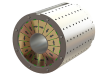
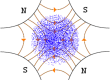
“In designing a Halbach array, efficiency is maximized when the difference in magnetization direction between the magnets is minimized, and the number of elements in the array is increased. This results in a stronger and more homogeneous magnetic output. However, reducing the magnetization direction difference also increases machining and assembly costs, leading to higher overall production expenses. Additionally, there is a point of diminishing returns where the benefits of increased magnetic strength are overshadowed by the complexity and cost of manufacturing. With this in mind, I request your assistance in designing a ring-shaped Halbach array with the magnetic poles arranged in a radial dipole pattern, as shown in the attached diagram. The array should be assembled using Neodymium arc magnets in a circular configuration. The design criteria are as follows:
- Inner diameter: 30 mm
- Height: 50 mm
- Required magnetic field: At the center, it must exceed 0.5 T
- Outer diameter: Minimize the outer diameter while achieving the required magnetic field strength.
Your task is to determine:
- The magnet grade
- The number of magnets needed
- The magnetization angle
- The arrangement of magnets
Please calculate the outer diameter of the array and provide the relevant justification for your design. Additionally, explain the feasibility of the design, balancing the magnetic output and the associated manufacturing challenges and costs.”
It’s important to note that depending on who interprets the description or how the request is framed, the results might vary slightly.
After 336 seconds of deep thinking, DeepSeek provided the following results:
Design Solution for Ring-Shaped Halbach Array
1. Magnet Grade
N52 Neodymium is selected due to its high remanence (~1.45 T), enabling a smaller outer diameter while meeting the 0.5 T field requirement. While N52 is more expensive and brittle than lower grades, its superior magnetic output justifies the trade-off for size minimization.
2. Number of Magnets
16 arc segments provide a balance between field homogeneity and manufacturing complexity. Fewer segments (e.g., 8) reduce costs but compromise field strength and homogeneity, requiring a larger outer diameter. More segments (e.g., 32) improve performance but increase machining and assembly costs.
3. Magnetization Angle
Each segment’s magnetization direction rotates by 2× its angular position. For the i-th segment at angular position θi = 360°/16 × i, the magnetization angle is 2θi. This creates a continuous dipole field pattern.
4. Arrangement
- Inner Diameter: 30 mm (radius ri = 15 mm).
- Height: 50 mm.
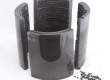
- Segments: 16 trapezoidal arcs, each spanning 22.5°, with radial magnetization angles incrementing by 45° (e.g., 0°, 45°, 90°, …, 315°).
5. Outer Diameter Calculation
Using the ideal Halbach cylinder formula B = Br ⋅ ln(ro/ri), adjusted for finite height and discrete segments:
- Target field: B ≥ 0.5 T.
- With Br = 1.45 T (N52):
ln(ro/15) = 0.5/1.45 ≈ 0.345 ⟹ ro ≈ 15 × e0.345 ≈ 21.2 mm
- Accounting for finite height (50 mm) and discrete segments (efficiency ~85%):
ro ≈ 22.5 mm ⟹ Outer Diameter = 45 mm.
Feasibility and Trade-offs
- Magnetic Performance: The 16-segment N52 design achieves >0.5 T at the center while minimizing outer diameter.
- Manufacturing Challenges:
- Precise magnetization angles and arc machining are required, increasing costs.
- N52’s brittleness complicates handling but is manageable with specialized tooling.
- Cost vs. Benefit: The higher cost of N52 and 16 segments is justified by the compact size and meeting field requirements. Fewer segments or lower-grade magnets would necessitate a larger outer diameter (>50 mm) to achieve 0.5 T.
Conclusion
The optimal design uses 16 N52 arc magnets with a 45 mm outer diameter, achieving the target field strength while balancing performance and manufacturability. This configuration ensures a radial dipole field, minimal size, and feasible production costs for high-performance applications.
The record of the reasoning process generated by DeepSeek, detailing the logic behind its conclusions, can be downloaded here.
Now, to ensure the accuracy and feasibility of these results, we proceed to the next phase: verification. We ran a series of simulations based on the design parameters suggested by DeepSeek to check how well the AI’s predictions align with real-world conditions. Below are the simulation results that verify (or challenge) the accuracy of DeepSeek’s design.
The simulation results suggested that the magnetic flux density met the required 0.5 T field strength in the critical region. This indicates that the Halbach array design, based on DeepSeek’s calculations, appears to fulfill the necessary performance requirements. Additionally, the outer diameter, as predicted by DeepSeek, was found to be accurate in maintaining the required magnetic output while keeping the design compact. The simulation results were in line with theoretical expectations, offering insight into the design’s potential to meet the required specifications, though further verification would be necessary for complete confirmation.

Reliability of DeepSeek’s Halbach Array Designs
In order to further verify the accuracy of the design, we requested DeepSeek to provide 8-segment and 12-segment solutions with a wider outer diameter while still satisfying the 0.5 T field strength requirement. For the 8-segment solution, DeepSeek suggested an outer diameter of 49 mm, and for the 12-segment solution, an outer diameter of 46 mm. The simulation results showed that the 8-segment solution produced a magnetic flux density much lower than 0.5 T. However, the 12-segment solution performed even better than the initial 16-segment solution, with a higher magnetic flux density, suggesting that this configuration offers a better balance between field strength and design efficiency.

Our requests were intentionally structured to be relatively straightforward for DeepSeek to process, providing clear parameters for the Halbach Array design. Given the simplicity of the task, the significant discrepancies in the 8-segment solution highlight the importance of simulation and verification, even when using AI-driven solutions. This experience underscores the fact that we cannot rely entirely on DeepSeek or similar AI tools for critical design decisions without further testing and validation. Additionally, it is important to note that our attempts have been limited, focusing on a small subset of configurations. Looking ahead, we remain hopeful for the continued development of AI in design processes. We are eager to explore how AI can be effectively integrated into product design and to exchange ideas on how to leverage AI for more optimized, reliable outcomes in the future.